Nathaniel Starkman

Nathaniel Starkman

Brinson Prize Fellow · Postdoc @ MIT Kavli Institute for Astrophysics

I am a computational astrophysicist researching dark matter — what it is, and how it shapes galaxies — mostly by using stellar streams to constrain their gravitational potentials, in the Milky Way and far beyond it with large-scale surveys.

When a star cluster is torn apart by its host galaxy, the debris can trace a long, thin stream. Properties of the stream — its path, shape, width, etc — are all sensitive to properties of the host, including its dark matter. I develop and apply novel methods to study these streams and learn about the dark matter; I also build much of the software powering these methods and analyses. I am also a core developer of Astropy, helping to power all of astronomy.

Selected publications

All publications →
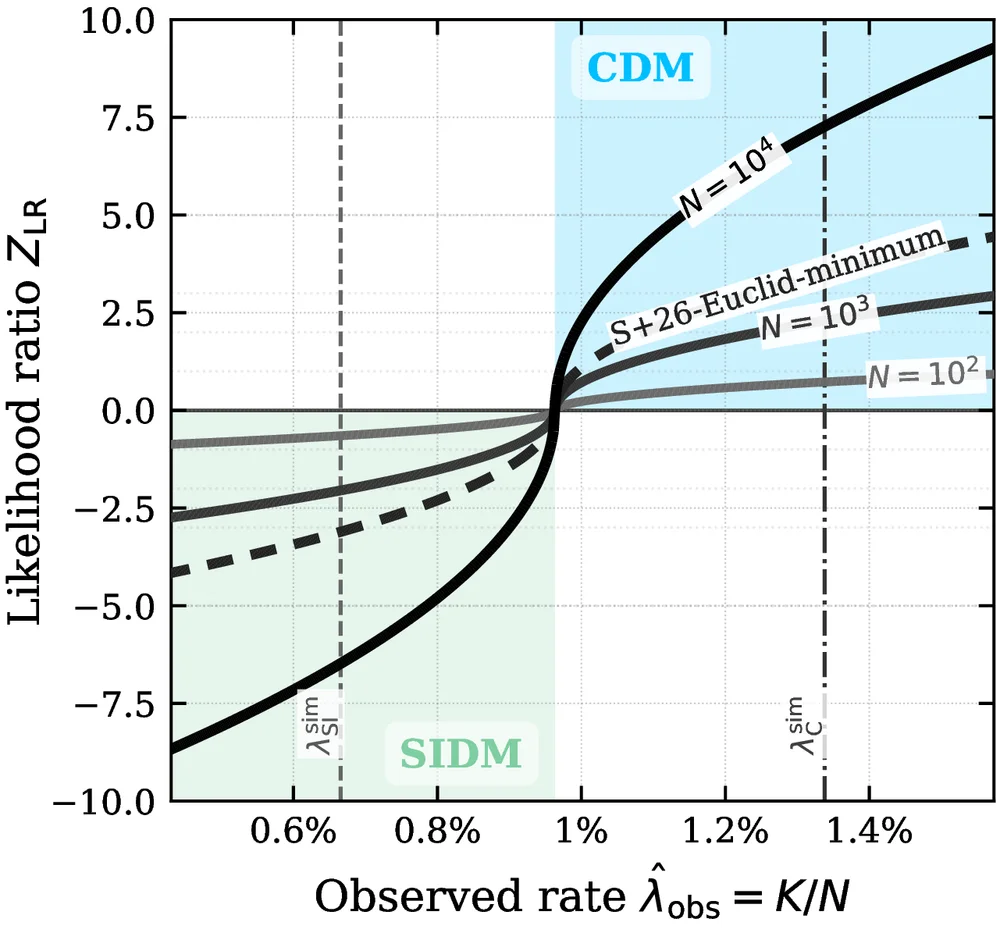
Likelihood ratio between CDM and SIDM plotted against the observed fraction of streams with a convex segment, for catalogs of 100, 1,000 and 10,000 streams. The curves steepen with catalog size; at 10,000 streams, either predicted rate is strongly favored.

arXiv:2609.40057·2026submitted·N. Starkman, J. Nibauer, et al.N. Starkman, J. Nibauer, S. Pearson, et al.N. Starkman, J. Nibauer, S. Pearson, S. Wu‡, L. Necib·arXiv:2609.40057·2026submitted

arXiv:2609.40057·2026submitted

Cold dark matter predicts triaxial halos; self-interacting dark matter rounds them toward spheres.

Cold dark matter predicts triaxial halos; self-interacting dark matter rounds them toward spheres. A stellar stream in a spherical halo can never curve away from its host galaxy’s center in projection, but one in a triaxial halo can. The rate of these convexities tracks halo shape across a population, so catalogs on the scale of Euclid, Rubin and Roman can tell CDM from SIDM at up to 5σ.
1st | 2026Context ›
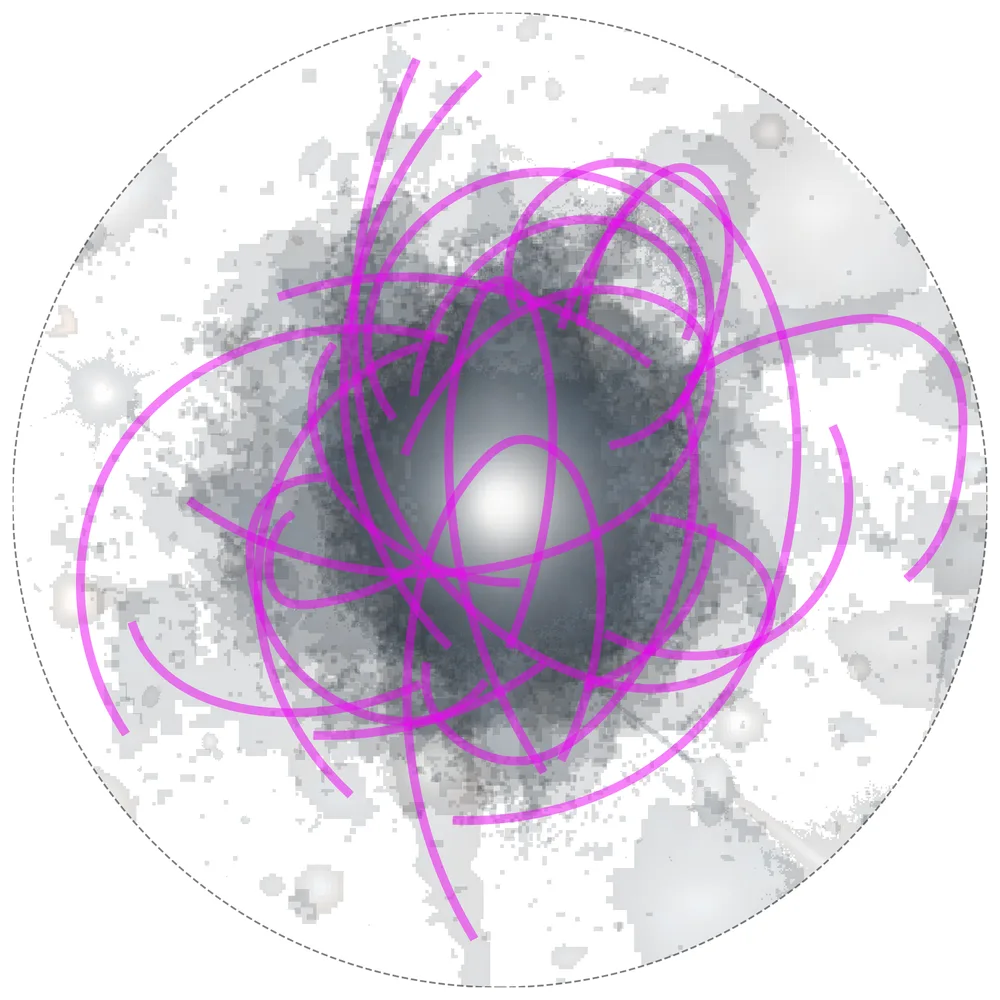
Stellar stream tracks from 13 Euclid galaxies, drawn as magenta curves and stacked over one host galaxy, as if every stream orbits a common center.

Astronomy & AstrophysicsA&A·2026submitted·Euclid Collaboration, N. Starkman, J. Nibauer, et al.Euclid Collaboration, N. Starkman, J. Nibauer, S. Pearson, et al.Euclid Collaboration, N. Starkman, J. Nibauer, S. Pearson, S. Wu‡, M. Walmsley, L. Necib, J. Bovy, F. R. Marleau, et al.·Astronomy & AstrophysicsA&A·2026submitted

Astronomy & AstrophysicsA&A·2026submitted

Euclid is turning up stellar streams around galaxies across a cosmological volume.

Euclid is turning up stellar streams around galaxies across a cosmological volume. A stream’s shape on the sky constrains the shape and center of its host’s dark matter halo, complementing weak lensing. Across 13 galaxies in Euclid’s first quick data release, halos are consistent with spherical, albeit with a mild preference for flattening, q = 0.95 (+0.05, −0.10), in line with ΛCDM. Thousands more streams are expected over the mission.

1st | 2026Context ›
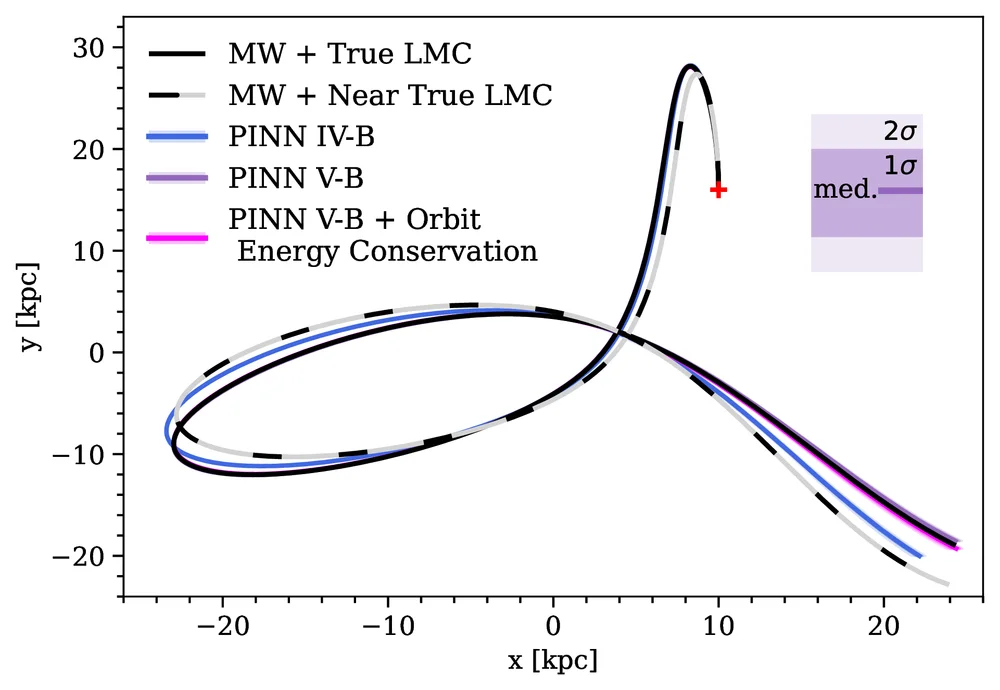
Orbits of a test particle in a Milky Way–LMC system, integrated in the true potential, a near-true analytic model, and three neural-network models. The most complete neural-network models track the true orbit almost exactly, while the near-true analytic model drifts away from it.

Monthly Notices of the Royal Astronomical SocietyMNRAS·2026submitted·C. Myers†, N. Starkman, et al.C. Myers†, N. Starkman, L. NecibC. Myers†, N. Starkman, L. Necib·Monthly Notices of the Royal Astronomical SocietyMNRAS·2026submitted

Monthly Notices of the Royal Astronomical SocietyMNRAS·2026submitted

A physics-informed neural network learns only the corrections to an analytic galactic potential, so it stays interpretable while reaching sub-percent acceleration errors and more faithful orbits than analytic models alone.

A physics-informed neural network learns only the corrections to an analytic galactic potential, so it stays interpretable while reaching sub-percent acceleration errors and more faithful orbits than analytic models alone. Bayesian and time-dependent extensions add uncertainties and follow the potential as it evolves. Led by undergraduate Charlotte Myers; code in galactoPINNs, first shown at NeurIPS 2025.

2nd | 2026Context ›
The unxt logo: a ruler crossed with a green pencil on a blue square.

Journal of Open Source Software 10, 7771JOSS 10, 7771·2025·N. Starkman, A. M. Price-Whelan, et al.N. Starkman, A. M. Price-Whelan, J. NibauerN. Starkman, A. M. Price-Whelan, J. Nibauer·Journal of Open Source Software 10, 7771JOSS 10, 7771·2025

Journal of Open Source Software 10, 7771JOSS 10, 7771·2025

JAX gives scientific Python automatic differentiation, compilation and GPUs, but no physical units.

JAX gives scientific Python automatic differentiation, compilation and GPUs, but no physical units. unxt adds them: quantities that carry their units through jitted, differentiated and vectorized code, with astropy.units under the hood and an interface astropy users will recognize. It underpins the GalacticDynamics stack, including coordinax and galax.

1st | 2025
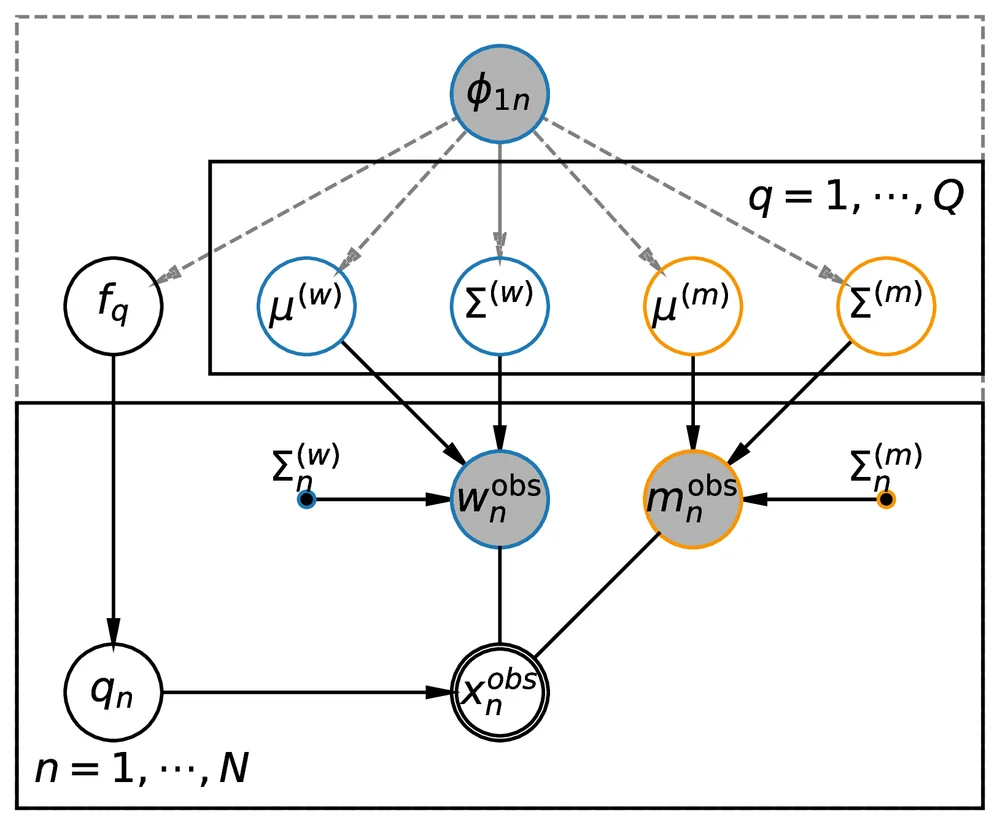
Probabilistic graphical model of the stream: each star’s observed astrometry and photometry come from a mixture of Gaussians whose weights, means and covariances are set by neural networks of its position along the stream, with each star’s measurement errors feeding in.

The Astrophysical Journal 980, 253ApJ 980, 253·2025·N. Starkman, J. Nibauer, et al.N. Starkman, J. Nibauer, J. Bovy, et al.N. Starkman, J. Nibauer, J. Bovy, J. Webb, K. Tavangar, A. Price-Whelan, A. Bonaca·The Astrophysical Journal 980, 253ApJ 980, 253·2025

The Astrophysical Journal 980, 253ApJ 980, 253·2025

Using a stellar stream to weigh the Milky Way’s dark matter starts with knowing which stars belong to it.

Using a stellar stream to weigh the Milky Way’s dark matter starts with knowing which stars belong to it. Mixture density networks model a stream’s track, width, density and kinematics from all the available astrometry and photometry, with normalizing flows for the background, even where phase-space data are incomplete. Applied to GD-1 and Palomar 5, the result is public catalogs of stellar membership probabilities.

1st | 2025Context ›

Background

2024 – 2027Postdoctoral Associate, MIT Kavli Institute for Astrophysics and Space ResearchBrinson Prize Fellowship (2024–2027).
2021 –Coordinator & Core Developer, AstropyRole: Member, Core Developer Team; lead maintainer for Cosmology, co-maintainer of Units.2025–2028: Coordination Committee (executive committee).2025–2026: Strategic Planning and Organizing Committee.Funding: Astropy Cycle III — Cosmology and Quantity 2.0.Team awards: 2025 AAS Lancelot M. Berkeley–New York Community Trust Prize, the 2023 IOP Publishing Top Cited Paper Award and the 2022 ADASS Prize for an Outstanding Contribution to Astronomical Software.
2018 – 2024PhD in Astronomy & Astrophysics, University of TorontoNSERC CGS-D Fellow 2020–2023. NSERC CGS-M Fellow 2019–2020.Thesis: Charting Stellar Streams of the Milky Way
2014 – 2018B.S. in Mathematical Physics and Astronomy, Case Western Reserve UniversitySumma Cum Laude.
The Astropy logo: a white spiral on an orange-to-red oval.

Core developer · Coordination Committee · Strategic Planning

Astronomy in Python

The community core package for astronomy in Python. The collaboration received the 2025 AAS Lancelot M. Berkeley Prize, a 2023 IOP Publishing Top Cited Paper Award and the 2022 ADASS software prize.

The galax logo, the GalacticDynamics mark: a painted spiral galaxy with a glowing core on a dark disk, circled by a dark ring, between a teal < and a purple > code bracket.

lead developer

Galactic dynamics in JAX

Orbit integration, potentials and stream generation — GPU-accelerated and fully differentiable.

maintainer

Multiple dispatch in Python

Multiple dispatch for Python, with type-hint-driven method resolution — the dispatch layer under quax and unxt.

The coordinax logo: a ruler crossed with a green arrow on a blue square.

lead developer

Coordinates in JAX

Vectors, frames and transformations — differentiable, and unit-aware via unxt.

The unxt logo: a ruler crossed with a green pencil on a blue square.

lead developer

Units in JAX

Unit-aware quantities that survive jit, grad and vmap.

maintainer

Multiple dispatch in JAX

Custom array-ish types that work with JAX primitives — the substrate the rest of the stack builds on.

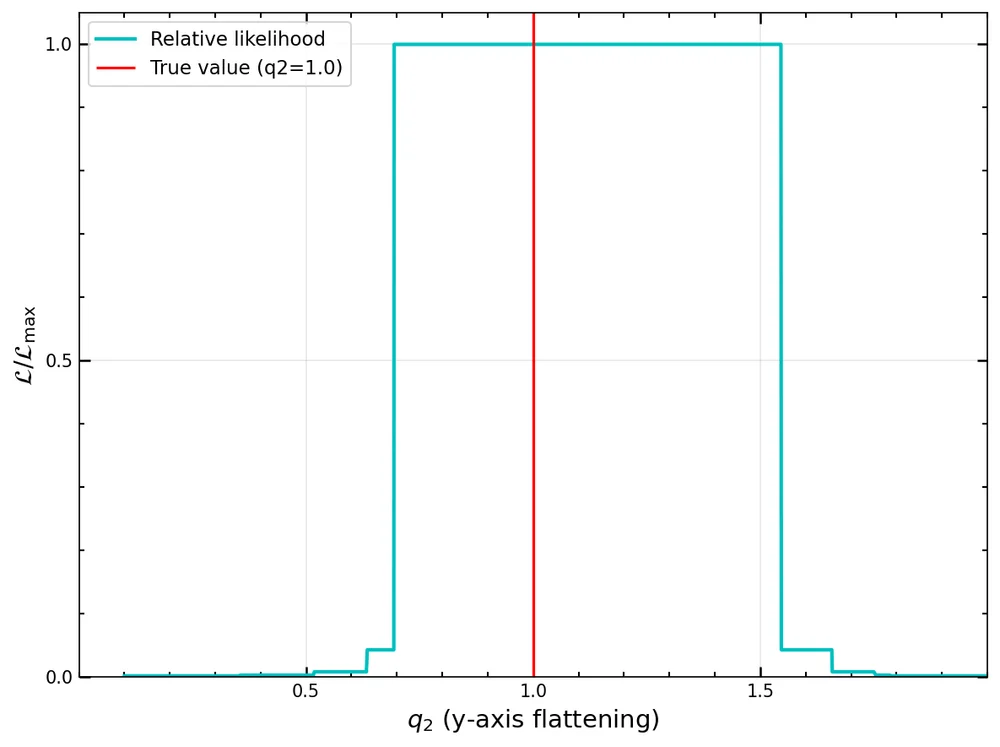
Relative likelihood of a halo’s y-axis flattening, q₂, from a Potamides tutorial: a flat plateau from about 0.7 to 1.55 that contains the true value, q₂ = 1, falling to zero on either side.

co-lead developer

Constrain gravitational potentials from stellar stream curvature

A JAX package that fits stream tracks with splines and compares their curvature directly to a potential's accelerations. Co-led with Sirui Wu.