Publications

Topics
|

Students I supervised or advised: undergraduate†, graduate‡.

Potamides: JAX tools for curvature-based inference from stellar streams

S. Wu‡, N. Starkman, J. Nibauer, S. Pearson

Journal of Open Source Software 11, 10712·2026
Potamides: JAX tools for curvature-based inference from stellar streamsPotamides: The SoftwarePotamides Software
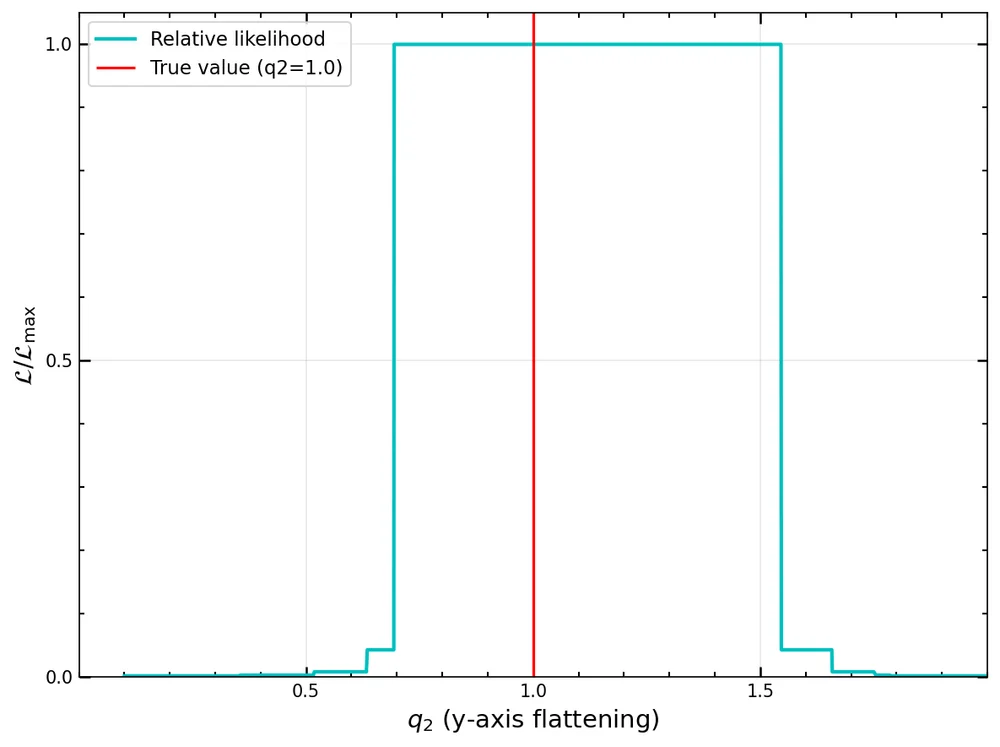
Relative likelihood of a halo’s y-axis flattening, q₂, from a Potamides tutorial: a flat plateau from about 0.7 to 1.55 that contains the true value, q₂ = 1, falling to zero on either side.

Journal of Open Source Software 11, 10712JOSS 11, 10712·2026·S. Wu‡, N. Starkman, et al.S. Wu‡, N. Starkman, J. Nibauer, et al.S. Wu‡, N. Starkman, J. Nibauer, S. Pearson·Journal of Open Source Software 11, 10712JOSS 11, 10712·2026

Journal of Open Source Software 11, 10712JOSS 11, 10712·2026

Potamides is a JAX package that infers a galaxy’s mass distribution from the shapes of its stellar streams.

Potamides is a JAX package that infers a galaxy’s mass distribution from the shapes of its stellar streams. Instead of simulating a stream for every trial potential, it fits the observed track with splines and compares its curvature directly to the potential’s accelerations, covering the pipeline from annotating streams to evaluating likelihoods. Led by Sirui Wu.

2nd | 20262026Context ›
Abstract

Potamides is a Python package for inferring the mass distribution of galaxies from the projected shapes of stellar streams in imaging data. Stellar streams are elongated structures produced when star clusters or dwarf galaxies are tidally disrupted by their host. Because their projected tracks carry information about the host's gravitational field, the local curvature of a stream can constrain the underlying potential. The package implements and extends the curvature-based likelihood framework of Nibauer et al. (2023). Rather than generating a full dynamical realization of a stellar stream for each trial model, Potamides represents observed stream tracks with JAX-based splines. It evaluates gravitational accelerations in candidate potentials and compares them directly to the local stream geometry. This provides a lower-cost inference workflow that complements traditional forward-modeling approaches. Potamides supports the complete analysis pipeline for a galaxy, from annotating stream ridge-lines to evaluating likelihoods across many potential models.
Potamides: Mapping Dark Matter Halo Shapes from Stellar Stream Tracks in the Local Universe

S. Wu‡, N. Starkman, S. Pearson, J. Nibauer, J. Miro-Carretero, D. Martinez-Delgado

The Astrophysical Journal·2026accepted

Potamides: Mapping Dark Matter Halo Shapes from Stellar Stream Tracks in the Local UniversePotamides: Halo Shapes from Stream CurvaturePotamidesaccepted
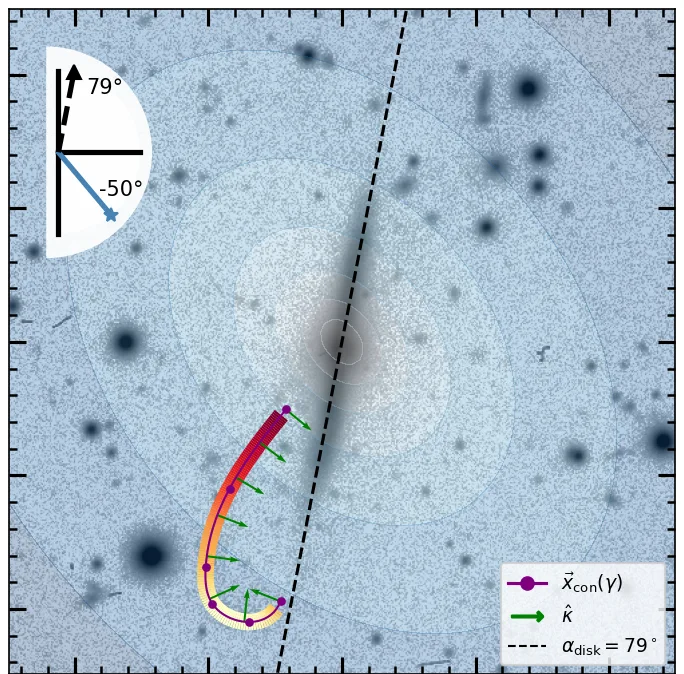
The galaxy ESO 186-063 seen edge-on, with its faint stellar stream fitted as a curved track. Arrows show the stream’s curvature, and the track is shaded by how often each point rejects a trial halo potential, over that potential’s equipotential contours.

The Astrophysical JournalApJ·2026accepted·S. Wu‡, N. Starkman, et al.S. Wu‡, N. Starkman, S. Pearson, et al.S. Wu‡, N. Starkman, S. Pearson, J. Nibauer, J. Miro-Carretero, D. Martinez-Delgado·The Astrophysical JournalApJ·2026accepted

The Astrophysical JournalApJ·2026accepted

A stellar stream’s curvature traces the pull of its host’s dark matter halo.

A stellar stream’s curvature traces the pull of its host’s dark matter halo. Applied to 15 streams from the Stellar Stream Legacy Survey, Potamides constrains each halo’s projected flattening and orientation. Streams with edge-on loops or sharp turns constrain it most, great-circle-like ones barely at all, and three hint that the stellar disk shapes the inner gravitational field. Led by Sirui Wu.

2nd | 20262026Context ›
Abstract

Stellar streams trace the gravitational potential of their host galaxies and offer a direct probe of dark matter halo geometry. Cosmological simulations predict that halo shapes depend on both baryonic physics and the nature of dark matter, yet observational constraints on halo flattening and orientation remain limited, especially for individual galaxies. We present Potamides, which utilizes the curvature of extragalactic stellar streams to derive constraints on halo shapes. We apply Potamides to 15 stellar streams from the Stellar Stream Legacy Survey to infer the projected axis ratios and orientation of their host halos. We find that some streams in our sample exclude large regions of halo flattenings and halo orientations. Systems with edge-on wrapping loops or sharp turning points yield the strongest constraints, whereas great circle-like streams remain largely uninformative. All streams in our sample support a spherical halo for a given flattening direction. These results demonstrate that stream morphology can provide halo shape constraints for individual external galaxies. With upcoming surveys (such as Euclid, Rubin, Roman, and ARRAKIHS) expected to discover large numbers of stellar streams, this curvature-based technique will enable rapid statistical tests of dark matter and baryonic physics through the shapes and alignments of halos and disks across cosmic time.

StreamSculptor: Hamiltonian Perturbation Theory for Stellar Streams in Flexible Potentials with Differentiable Simulations

J. Nibauer, A. Bonaca, D. N. Spergel, A. M. Price-Whelan, J. E. Greene, N. Starkman, K. V. Johnston

The Astrophysical Journal 983, 68·2025

StreamSculptor: Hamiltonian Perturbation Theory for Stellar Streams in Flexible Potentials with Differentiable SimulationsStreamSculptor
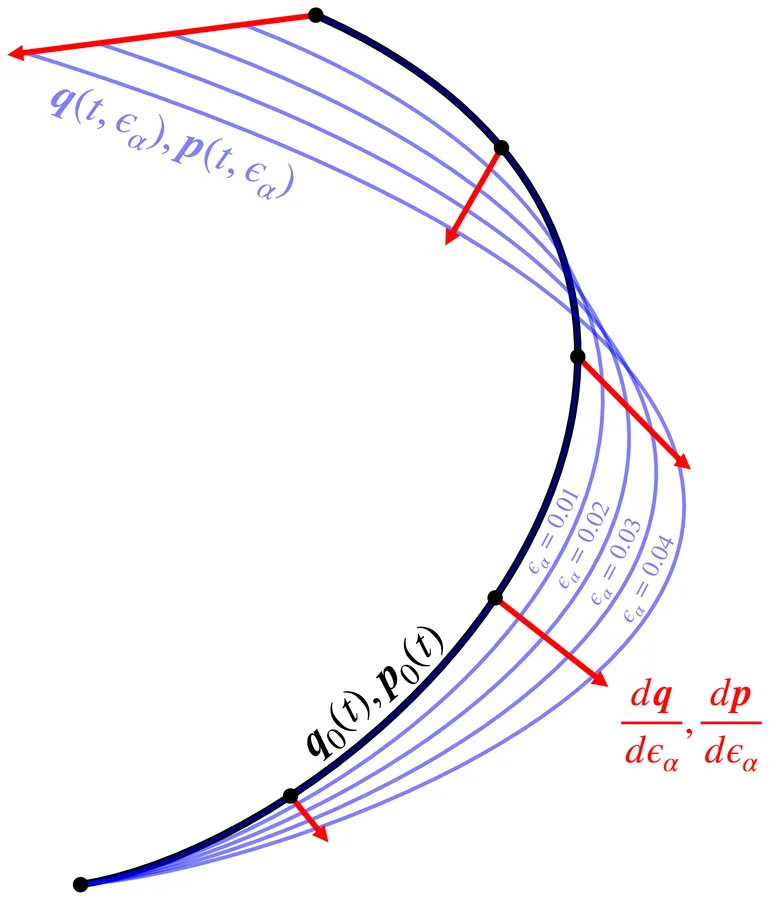
Sketch of the method: a black base orbit with a fan of blue orbits beside it, each bent a little further as the perturbation strength grows from 0.01 to 0.04. Red arrows along the base orbit show the derivatives that predict that bending.

The Astrophysical Journal 983, 68ApJ 983, 68·2025·J. Nibauer, …, N. Starkman, et al.J. Nibauer, …, N. Starkman, et al.J. Nibauer, A. Bonaca, D. N. Spergel, A. M. Price-Whelan, J. E. Greene, N. Starkman, K. V. Johnston·The Astrophysical Journal 983, 68ApJ 983, 68·2025

The Astrophysical Journal 983, 68ApJ 983, 68·2025

Stellar streams are sensitive to the smallest dark matter subhalos.

Stellar streams are sensitive to the smallest dark matter subhalos. StreamSculptor uses Hamiltonian perturbation theory to model streams in time-dependent potentials, capturing the LMC and the Galactic bar alongside the dozens of subhalo impacts expected for streams like GD-1 and Pal 5. A stream’s velocity dispersion then ties directly to dark matter physics, giving a fast way to model whole stream populations from dark matter properties. Led by Jacob Nibauer.

nth | 20252025Context ›
Abstract

Stellar streams retain a memory of their gravitational interactions with small-scale perturbations. While perturbative models for streams have been formulated in action-angle coordinates, a direct transformation to these coordinates is only available for static and typically axisymmetric models for the galaxy. The real Milky Way potential is in a state of disequilibrium, complicating the application of perturbative methods around an equilibrium system. Here, we utilize a combination of differentiable simulations and Hamiltonian perturbation theory to model the leading-order effect of dark matter subhalos on stream observables. To obtain a perturbative description of streams, we develop a direct and efficient forward mode differentiation of Hamilton's equations of motion. Our model operates in observable coordinates, allowing us to treat the effects of arbitrary subhalo potentials on streams perturbatively, while simultaneously capturing non-linear effects due to other substructures like the infalling LMC or the rotating bar. The model predicts the velocity dispersion of streams as a function of subhalo statistics, allowing us to constrain the low-mass range of subhalos down to 105 M⊙. We forecast the velocity dispersion of the GD-1 stream, and find that observations are in agreement with a CDM subhalo population, with a slight preference for more dense subhalos. The method provides a new approach to characterize streams in the presence of substructure, with significantly more modeling flexibility compared to previous works.

unxt: A Python package for unit-aware computing with JAX

N. Starkman, A. M. Price-Whelan, J. Nibauer

Journal of Open Source Software 10, 7771·2025

unxt: A Python package for unit-aware computing with JAXunxt
The unxt logo: a ruler crossed with a green pencil on a blue square.

Journal of Open Source Software 10, 7771JOSS 10, 7771·2025·N. Starkman, A. M. Price-Whelan, et al.N. Starkman, A. M. Price-Whelan, J. NibauerN. Starkman, A. M. Price-Whelan, J. Nibauer·Journal of Open Source Software 10, 7771JOSS 10, 7771·2025

Journal of Open Source Software 10, 7771JOSS 10, 7771·2025

JAX gives scientific Python automatic differentiation, compilation and GPUs, but no physical units.

JAX gives scientific Python automatic differentiation, compilation and GPUs, but no physical units. unxt adds them: quantities that carry their units through jitted, differentiated and vectorized code, with astropy.units under the hood and an interface astropy users will recognize. It underpins the GalacticDynamics stack, including coordinax and galax.

1st | 20252025
Abstract

unxt is a Python package for unit-aware computing with JAX. unxt is built on top of quax, which provides a framework for building array-like objects that can be used with JAX. unxt extends quax to provide support for unit-aware computing using the astropy.units package as a units backend. unxt provides seamless integration of physical units into high performance numerical computations, significantly enhancing the capabilities of JAX for scientific applications.

Stream Members Only: Data-Driven Characterization of Stellar Streams with Mixture Density Networks

N. Starkman, J. Nibauer, J. Bovy, J. Webb, K. Tavangar, A. Price-Whelan, A. Bonaca

The Astrophysical Journal 980, 253·2025

Stream Members Only: Data-Driven Characterization of Stellar Streams with Mixture Density NetworksStream Members Only
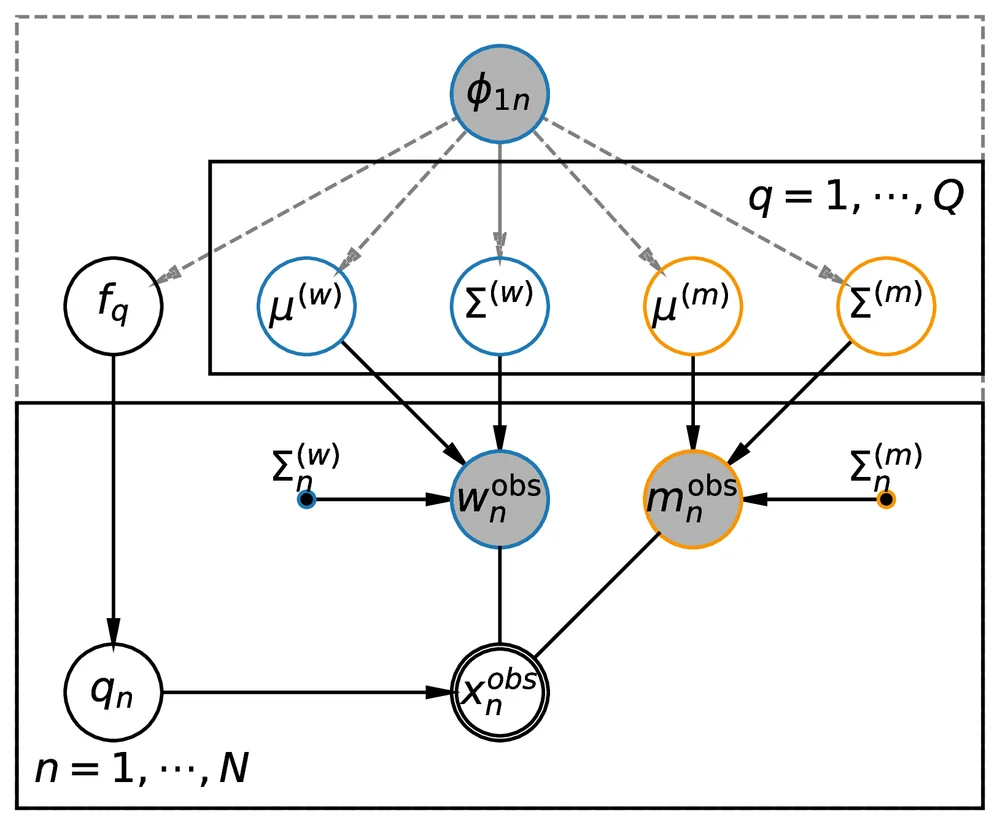
Probabilistic graphical model of the stream: each star’s observed astrometry and photometry come from a mixture of Gaussians whose weights, means and covariances are set by neural networks of its position along the stream, with each star’s measurement errors feeding in.

The Astrophysical Journal 980, 253ApJ 980, 253·2025·N. Starkman, J. Nibauer, et al.N. Starkman, J. Nibauer, J. Bovy, et al.N. Starkman, J. Nibauer, J. Bovy, J. Webb, K. Tavangar, A. Price-Whelan, A. Bonaca·The Astrophysical Journal 980, 253ApJ 980, 253·2025

The Astrophysical Journal 980, 253ApJ 980, 253·2025

Using a stellar stream to weigh the Milky Way’s dark matter starts with knowing which stars belong to it.

Using a stellar stream to weigh the Milky Way’s dark matter starts with knowing which stars belong to it. Mixture density networks model a stream’s track, width, density and kinematics from all the available astrometry and photometry, with normalizing flows for the background, even where phase-space data are incomplete. Applied to GD-1 and Palomar 5, the result is public catalogs of stellar membership probabilities.

1st | 20252025Context ›
Abstract

Stellar streams are sensitive probes of the Milky Way’s gravitational potential. The mean track of a stream constrains global properties of the potential, while its fine-grained surface density constrains galactic substructure. A precise characterization of streams from potentially noisy data marks a crucial step in inferring galactic structure, including the dark matter, across orders of magnitude in mass scales. Here we present a new method for constructing a smooth probability density model of stellar streams using all of the available astrometric and photometric data. To characterize a stream’s morphology and kinematics, we utilize mixture density networks to represent its on-sky track, width, stellar number density, and kinematic distribution. We model the photometry for each stream as a single-stellar population, with a distance track that is simultaneously estimated from the stream’s inferred distance modulus (using photometry) and parallax distribution (using astrometry). We use normalizing flows to characterize the distribution of background stars. We apply the method to the stream GD-1, and the tidal tails of Palomar 5. For both streams we obtain a catalog of stellar membership probabilities that are made publicly available. Importantly, our model is capable of handling data with incomplete phase-space observations, making our method applicable to the growing census of Milky Way stellar streams.

Angular Correlations of Cosmic Microwave Background Spectrum Distortions from Photon Diffusion

N. Starkman, G. Starkman, A. Kosowsky

Monthly Notices of the Royal Astronomical Society 529, 2274·2024

Angular Correlations of Cosmic Microwave Background Spectrum Distortions from Photon DiffusionCMB Spectrum Distortions from Photon DiffusionCMB Spectrum Distortions
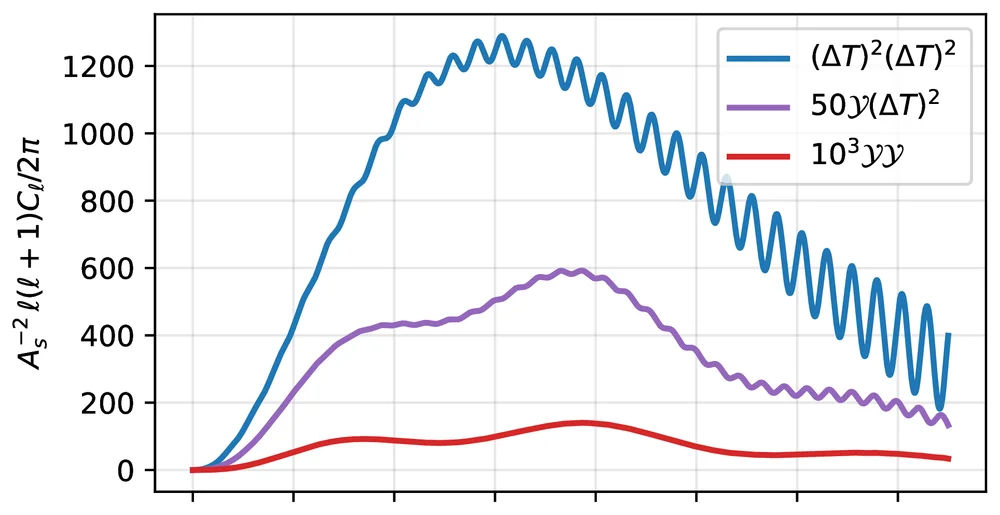
Angular power spectra of the squared temperature fluctuations (blue), their cross-correlation with the diffusion y-distortion (purple, scaled by 50), and the y-distortion’s own autocorrelation (red, scaled by 1000). The blue and purple curves carry acoustic oscillations.

Monthly Notices of the Royal Astronomical Society 529, 2274MNRAS 529, 2274·2024·N. Starkman, G. Starkman, et al.N. Starkman, G. Starkman, A. KosowskyN. Starkman, G. Starkman, A. Kosowsky·Monthly Notices of the Royal Astronomical Society 529, 2274MNRAS 529, 2274·2024

Monthly Notices of the Royal Astronomical Society 529, 2274MNRAS 529, 2274·2024

As the universe became transparent, the photons reaching us from any one direction last scattered off regions at slightly different temperatures.

As the universe became transparent, the photons reaching us from any one direction last scattered off regions at slightly different temperatures. Blending those blackbodies leaves a small Compton y-distortion in the CMB spectrum. Its cross-correlation with the squared temperature fluctuations should already be detectable by ACT and SPT, at a forecast signal-to-noise of about 12, and CMB-S4 could turn it into a new cosmological probe.

1st | 20242024Context ›
Abstract

During cosmic recombination, charged particles bind into neutral atoms and the mean free path of photons rapidly increases, resulting in the familiar diffusion damping of primordial radiation temperature variations. An additional effect is a small photon spectrum distortion, because photons arriving from a particular sky direction were originally in thermal equilibrium at various spatial locations with different temperatures; the combination of these different blackbody temperature distributions results in a spectrum with a Compton y-distortion. Using the approximation that photons had zero mean free path prior to their second-to-last scattering, we derive an expression for the resulting y-distortion, and compute the angular correlation function of the diffusion y-distortion and its cross-correlation with the square of the photon temperature fluctuation. Detection of the cross-correlation is within reach of existing arcminute-resolution microwave background experiments such as the Atacama Cosmology Telescope and the South Pole Telescope.

On the fast track: Rapid construction of stellar stream paths

N. Starkman, J. Bovy, J. Webb, D. Calvetti, E. Somersalo

Monthly Notices of the Royal Astronomical Society 522, 5022·2023

On the fast track: Rapid construction of stellar stream pathsOn the Fast Track
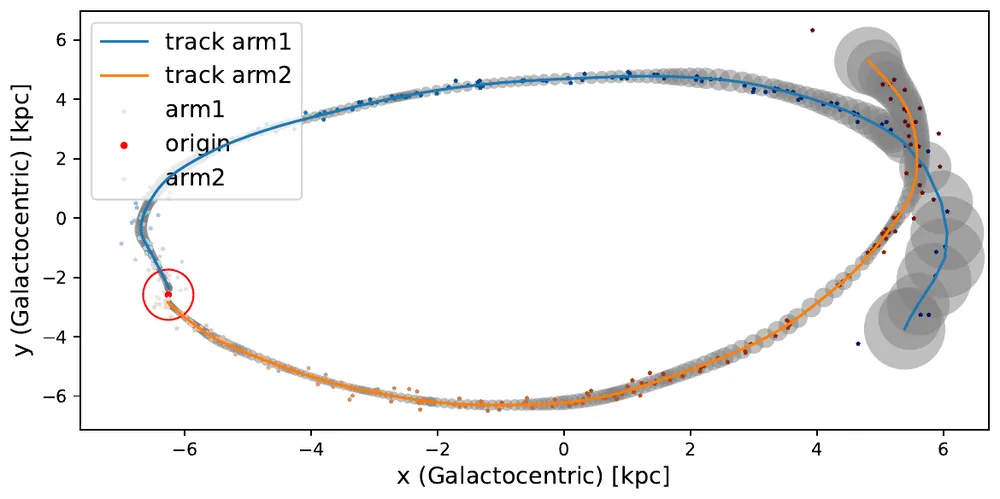
A simulated stellar stream from a 47 Tucanae-like progenitor, looping around the Galactic centre in Galactocentric x–y coordinates. Blue and orange lines trace the fitted path of each tidal arm, wrapped in grey uncertainty ellipses that grow largest at the arms’ sparse far ends.

Monthly Notices of the Royal Astronomical Society 522, 5022MNRAS 522, 5022·2023·N. Starkman, J. Bovy, et al.N. Starkman, J. Bovy, J. Webb, et al.N. Starkman, J. Bovy, J. Webb, D. Calvetti, E. Somersalo·Monthly Notices of the Royal Astronomical Society 522, 5022MNRAS 522, 5022·2023

Monthly Notices of the Royal Astronomical Society 522, 5022MNRAS 522, 5022·2023

Comparing a stellar stream to simulations first needs a clear map of the stream’s path.

Comparing a stellar stream to simulations first needs a clear map of the stream’s path. This method puts the stars in order along the stream, then traces the path and its uncertainty — without assuming any model of the Galaxy. It works on simulated streams and on real ones like Palomar 5 and GD-1, and is available as the Python package TrackStream.

1st | 20232023Context ›
Abstract

Stellar streams are sensitive probes of the Galactic potential. The likelihood of a stream model given stream data is often assessed using simulations. However, comparing to simulations is challenging when even the stream paths can be hard to quantify. Here we present a novel application of self-organizing maps and first-order Kalman filters to reconstruct a stream’s path, propagating measurement errors and data sparsity into the stream path uncertainty. The technique is Galactic-model independent, non-parametric, and works on phase-wrapped streams. With this technique, we can uniformly analyse and compare data with simulations, enabling both comparison of simulation techniques and ensemble analysis with stream tracks of many stellar streams. Our method is implemented in the public Python package TrackStream, available at https://github.com/nstarman/trackstream.

The Astropy Project: Sustaining and Growing a Community-oriented Open-source Project and the Latest Major Release (v5.0) of the Core Package

The Astropy Collaboration, A. M. Price-Whelan, P. L. Lim, N. Earl, N. Starkman, L. Bradley, D. L. Shupe, A. A. Patil, L. Corrales, et al.

The Astrophysical Journal 935, 167·2022

The Astropy Project: Sustaining and Growing a Community-oriented Open-source Project and the Latest Major Release (v5.0) of the Core PackageThe Astropy Project: v5.0 and BeyondAstropy v5.0
The Astropy logo: a white spiral on an orange-to-red oval.

The Astrophysical Journal 935, 167ApJ 935, 167·2022·The Astropy Collaboration, A. M. Price-Whelan, …, N. Starkman, et al.The Astropy Collaboration, A. M. Price-Whelan, …, N. Starkman, et al.The Astropy Collaboration, A. M. Price-Whelan, P. L. Lim, N. Earl, N. Starkman, L. Bradley, D. L. Shupe, A. A. Patil, L. Corrales, et al.·The Astrophysical Journal 935, 167ApJ 935, 167·2022

The Astrophysical Journal 935, 167ApJ 935, 167·2022

Astropy is the shared foundation of Python astronomy: a core package for units, coordinates, tables, file I/O and more, and an ecosystem of interoperable packages built on it.

Astropy is the shared foundation of Python astronomy: a core package for units, coordinates, tables, file I/O and more, and an ecosystem of interoperable packages built on it. This paper describes the v5.0 release and the state of the Project, including its ties to observatories and missions and Learn Astropy, and confronts the challenge of sustaining a community-run codebase that much of astronomy now depends on.

4th | 20222022
Abstract

The Astropy Project supports and fosters the development of open-source and openly-developed Python packages that provide commonly needed functionality to the astronomical community. A key element of the Astropy Project is the core package astropy, which serves as the foundation for more specialized projects and packages. In this article, we summarize key features in the core package as of the recent major release, version 5.0, and provide major updates for the Project. We then discuss supporting a broader ecosystem of interoperable packages, including connections with several astronomical observatories and missions. We also revisit the future outlook of the Astropy Project and the current status of Learn Astropy. We conclude by raising and discussing the current and future challenges facing the Project.

Straight Lightning as a Signature of Macroscopic Dark Matter

N. Starkman, J. S. Sidhu, H. Winch, G. Starkman

Physical Review D 103, 063024·2020

Straight Lightning as a Signature of Macroscopic Dark MatterStraight Lightning from Macroscopic Dark MatterMacro Lightning
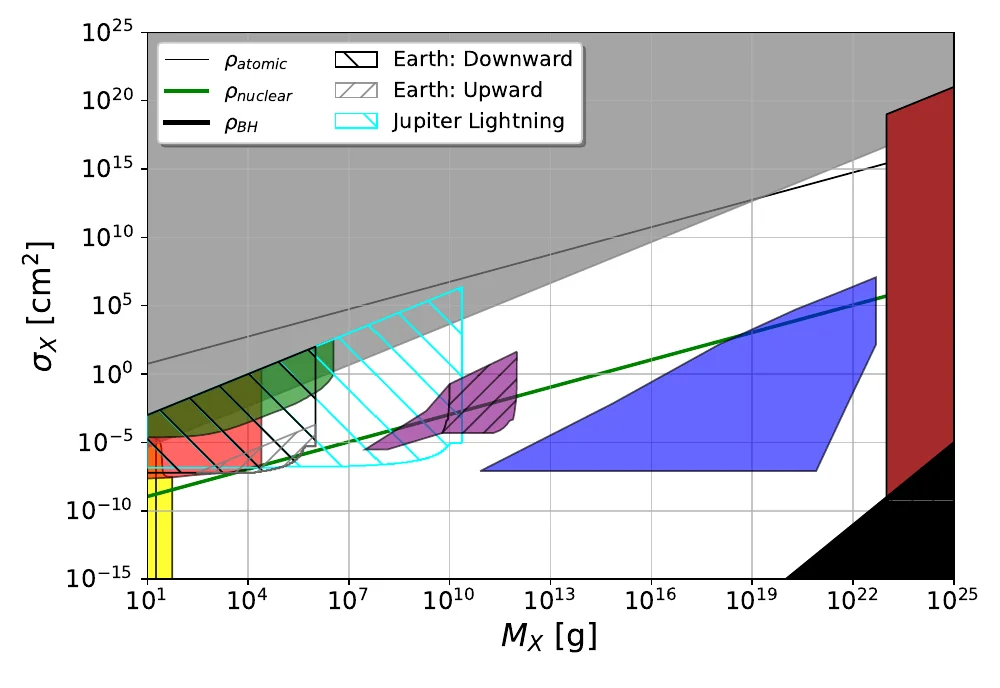
Macro dark matter parameter space, cross-section against mass, both on log axes. Colored regions are existing constraints; black and grey hatching marks what a search for straight lightning on Earth could probe, and cyan hatching what Jupiter could, reaching to heavier macros than the Earth search.

Physical Review D 103, 063024PRD 103, 063024·2020·N. Starkman, J. S. Sidhu, et al.N. Starkman, J. S. Sidhu, H. Winch, et al.N. Starkman, J. S. Sidhu, H. Winch, G. Starkman·Physical Review D 103, 063024PRD 103, 063024·2020

Physical Review D 103, 063024PRD 103, 063024·2020

Dark matter might be large objects — macros — rather than tiny particles.

Dark matter might be large objects — macros — rather than tiny particles. A macro passing through a thunderstorm would trigger a perfectly straight lightning bolt, unlike the jagged bolts we normally see. Looking for straight lightning on Earth, or on Jupiter, could test this idea.

1st | 20202020Context ›
Abstract

Macroscopic dark matter (macros) is a broad class of alternative candidates to particle dark matter. These candidates would transfer energy to matter primarily through elastic scattering. A sufficiently large macro passing through the atmosphere would produce a straight channel of ionized plasma. If the cross-section of the macro is σx⪆6×10⁻⁹ cm2, then under atmospheric conditions conducive to lightning (eg. a thunderstorm) the plasma channel would be sufficient to seed a lightning strike with a single leader. This is entirely unlike ordinary bolt lightning in which a long sequence of hundreds or thousands of few-meter-long leaders are strung together. This macro-induced lightning would be extremely straight, and thus highly distinctive. Neither wind shear nor magnetohydrodynamic instabilities would markedly spoil its straightness. The only photographically documented case of a straight lightning bolt is probably not straight enough to have been macro-induced. We estimate the region of macro parameter space that could be probed by a search for straight lightning from the number of thunderstorms happening on Earth at any time. We also estimate the parameter space that can be probed by carefully monitoring Jupiter, e.g. using the Hubble Space Telescope. All code and data is available at https://github.com/cwru-pat/macro_lightning.

An extended Pal 5 stream in Gaia DR2

N. Starkman, J. Bovy, J. Webb

Monthly Notices of the Royal Astronomical Society·2020

An extended Pal 5 stream in Gaia DR2An Extended Pal 5 Stream in Gaia DR2Extended Pal 5
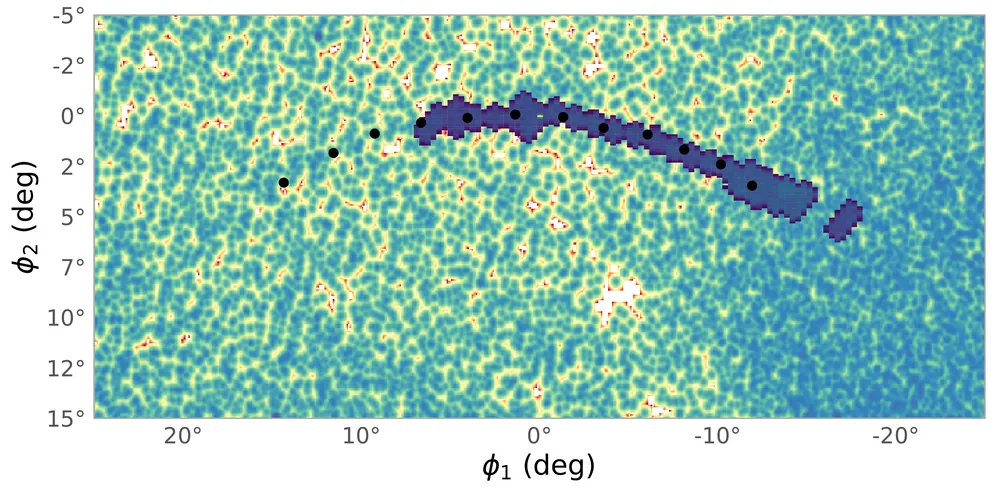
Smoothed density map of Gaia DR2 stars around the Palomar 5 globular cluster, in coordinates aligned with its tidal tails. A dark band marks the stream detected in earlier CFHT data, mostly the trailing arm; black dots trace the tails found here, matching that band and continuing about 7 degrees further along the leading arm.

Monthly Notices of the Royal Astronomical SocietyMNRAS·2020·N. Starkman, J. Bovy, et al.N. Starkman, J. Bovy, J. WebbN. Starkman, J. Bovy, J. Webb·Monthly Notices of the Royal Astronomical SocietyMNRAS·2020

Monthly Notices of the Royal Astronomical SocietyMNRAS·2020

Palomar 5 is a star cluster being pulled apart by the Milky Way, leaving two tails of stars that trace the Galaxy’s gravity.

Palomar 5 is a star cluster being pulled apart by the Milky Way, leaving two tails of stars that trace the Galaxy’s gravity. Gaia data show its leading tail runs about 7° further than was known, making the stream about 30° long. The two tails come out roughly equal, which limits how much the Galactic bar can have cut one short.

1st | 20202020Context ›
Abstract

We present the results of a detailed search for members of the Pal 5 tidal tail system in Gaia Data Release 2 (DR2). Tidal tails provide a sensitive method for measuring the current and past gravitational potential of their host galaxy as well as for testing predictions for the abundance of dark matter subhaloes. The Pal 5 globular cluster and its associated tails are an excellent candidate for such analysis; however, only ∼23° of arc are currently known, with in particular the leading tail much shorter than the trailing. Using Gaia DR2 and its precise astrometry, we extend the known extent of the Pal 5 tail to ∼30°, 7° of which are newly detected along the leading arm. The detected leading and trailing arms are symmetric in length and remain near constant width. This detection constrains proposed models in which the Galactic bar truncates Pal 5’s leading arm. Follow-up spectroscopic observations are necessary to verify the candidate stream stars are consistent with the known tidal tails. If confirmed, this Pal 5 stream extension opens up new possibilities to constrain the Galactic potential.

A constant characteristic volume density of dark matter haloes from SPARC rotation curve fits

P. Li, F. Lelli, S. S. McGaugh, N. Starkman, J. M. Schombert

Monthly Notices of the Royal Astronomical Society·2018

A constant characteristic volume density of dark matter haloes from SPARC rotation curve fitsA Constant Dark-Matter Halo DensitySPARC Halo Density
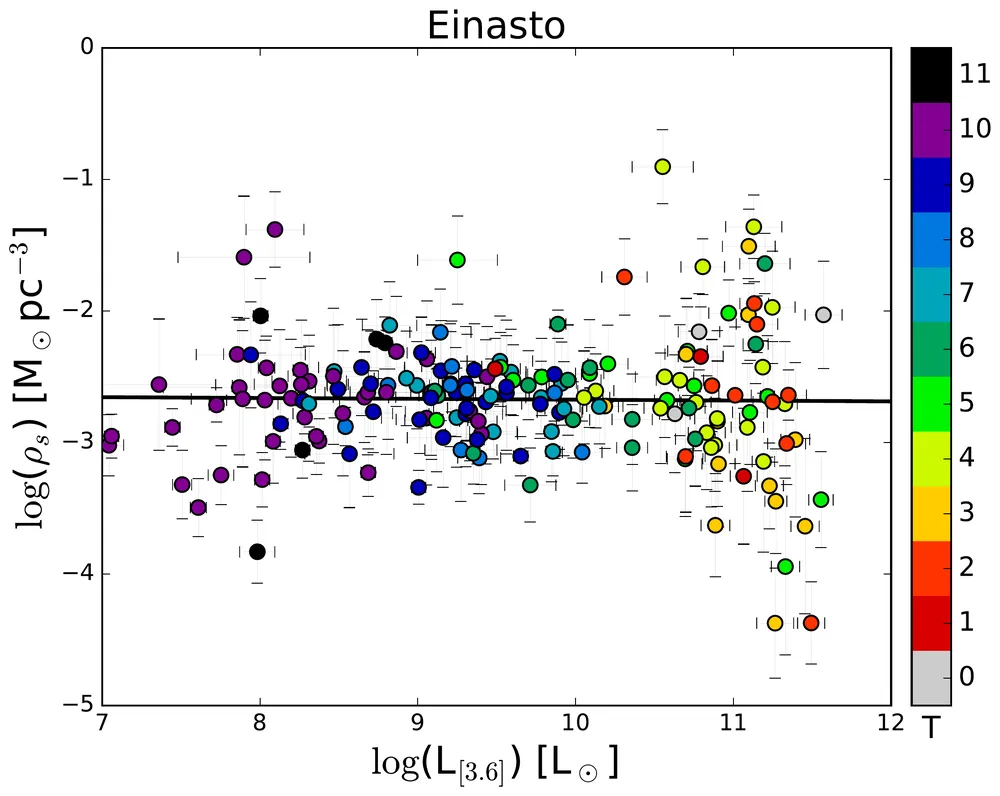
Characteristic dark-matter density of each SPARC galaxy’s Einasto halo against its 3.6-micron luminosity, coloured by Hubble type from S0 to blue compact dwarf. The points scatter around a flat line across five decades in luminosity.

Monthly Notices of the Royal Astronomical SocietyMNRAS·2018·P. Li, …, N. Starkman, et al.P. Li, …, N. Starkman, et al.P. Li, F. Lelli, S. S. McGaugh, N. Starkman, J. M. Schombert·Monthly Notices of the Royal Astronomical SocietyMNRAS·2018

Monthly Notices of the Royal Astronomical SocietyMNRAS·2018

How dark-matter haloes grow with the galaxies inside them is a direct test of how galaxies form.

How dark-matter haloes grow with the galaxies inside them is a direct test of how galaxies form. Fitting the rotation curves of 175 SPARC galaxies shows that bigger galaxies have bigger haloes, but the haloes’ typical density stays about the same — across galaxies that differ a hundred-thousand-fold in brightness.

nth | 20182018Context ›
Abstract

We study the scaling relations between dark matter (DM) haloes and galaxy discs using 175 galaxies from the SPARC database. We explore two cosmologically motivated DM halo profiles: the Einasto profile from DM-only simulations and the DC14 profile from hydrodynamic simulations. We fit the observed rotation curves using a Markov Chain Monte Carlo method and break the disc-halo degeneracy using near-infrared photometry and ΛCDM-motivated priors. We find that the characteristic volume density ρs of DM haloes is nearly constant over 5 decades in galaxy luminosity. The scale radius rs and the characteristic surface density ρs⋅rs, instead, correlate with galaxy luminosity. These scaling relations provide an empirical benchmark to cosmological simulations of galaxy formation.

A new algorithm to quantify maximum discs in galaxies

N. Starkman, F. Lelli, S. S. McGaugh, J. Schombert

Monthly Notices of the Royal Astronomical Society 480, 2292·2018

A new algorithm to quantify maximum discs in galaxiesQuantifying Maximum DiscsMaximum Discs
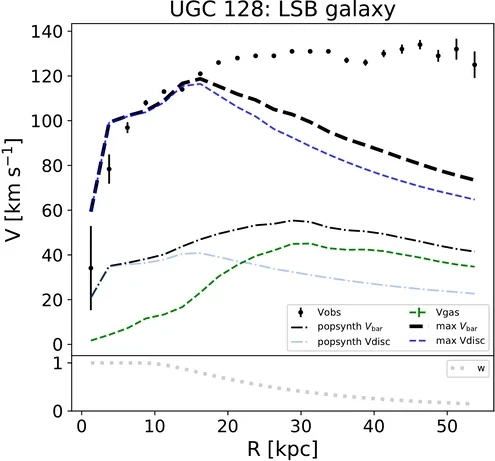
Rotation curve of the low-surface-brightness galaxy UGC 128: the observed speeds as points with error bars, the gas contribution, and the stellar disc and total baryonic contributions at both the stellar-population mass-to-light ratio and the maximum-disc value. Making its disc maximal needs a far heavier disc than its stars imply.

Monthly Notices of the Royal Astronomical Society 480, 2292MNRAS 480, 2292·2018·N. Starkman, F. Lelli, et al.N. Starkman, F. Lelli, S. S. McGaugh, et al.N. Starkman, F. Lelli, S. S. McGaugh, J. Schombert·Monthly Notices of the Royal Astronomical Society 480, 2292MNRAS 480, 2292·2018

Monthly Notices of the Royal Astronomical Society 480, 2292MNRAS 480, 2292·2018

A galaxy’s rotation comes from both its stars and its dark matter.

A galaxy’s rotation comes from both its stars and its dark matter. A “maximum disc” gives the stars as much of that rotation as possible, but the term was never precisely defined. A new algorithm measures it across 153 SPARC galaxies: bright galaxies come close to a maximum disc, while faint ones cannot — their stars would have to be unrealistically heavy for their light.

1st | 20182018Context ›
Abstract

Maximum disc decompositions of rotation curves place a dynamical upper limit to the mass attributable to stars in galaxies. The precise definition of this term, however, can be vague and varies in usage. We develop an algorithm to robustly quantify maximum-disc mass models and apply it to 153 galaxies from the SPARC database. Our automatic procedure recovers classic results from manual decompositions. High-mass, high-surface-brightness galaxies have mean maximum-disc mass-to-light ratios of ∼0.7M⊙/L⊙ in the Spitzer 3.6 μm band, which are close to the expectations from stellar population models, suggesting that these galaxies are nearly maximal. Low-mass, low-surface-brightness galaxies have very high maximum-disc mass-to-light ratios (up to 10 M⊙/L⊙), which are unphysical for standard stellar population models, confirming they are sub-maximal. The maximum-disc mass-to-light ratios are more closely correlated with surface brightness than luminosity. The mean ratio between baryonic and observed velocity at the peak of the baryonic contribution is Vbar/Vp≈0.88, but correlates with surface brightness, so it is unwise to use this mean value to define the maximum disc concept. Our algorithm requires no manual intervention and could be applied to large galaxy samples from future HI surveys with Apertif, Askap, and SKA.

Assists

Papers that thank me in their acknowledgements