Research

Collaborators

One of the great pleasures of astrophysics is doing fun work with fun people. This is an (incomplete) record of the people I have been lucky enough to write papers with, or to help with theirs.

wrote or assisted on a paper togetheranother postone person over timeEqual Earth projection
Jo Bovy — University of Toronto — Toronto, CA (2015-07–present); 4 papers together, 1 assistC. E. Brasseur — Lowell Observatory — Flagstaff, US (2025-10–present)C. E. Brasseur — University of St Andrews — St Andrews, GB (2021-10–2025-06); 1 paper togetherC. E. Brasseur — Liverpool John Moores University — Liverpool, GB (2017-09–2019-10)C. E. Brasseur — Space Telescope Science Institute — Baltimore, US (2016-05–2021-08)C. E. Brasseur — Mills College — Oakland, US (2008-08–2010-05)C. E. Brasseur — Oberlin College — Oberlin, US (2004-08–2008-05)Daniela Calvetti — Case Western Reserve University — Cleveland, US (1997-08–present); 1 paper togetherYingtian Chen — The Ohio State University — Columbus, US (2026-10–present)Yingtian Chen — University of Michigan — Ann Arbor, US (2020-09–2026-08); 1 assistYingtian Chen — Massachusetts Institute of Technology — Cambridge, US (2019-07–2019-08)Yingtian Chen — Peking University — Beijing, CN (2016-09–2020-07)Yingtian Chen — Chengdu Experimental Foreign Languages School — Chengdu, CN (2010-09–2016-07)Lia Corrales — University of Michigan — Ann Arbor, US (2020-09–present); 1 paper togetherLia Corrales — University of Michigan — Ann Arbor, US (2018-09–2020-08)Lia Corrales — University of Wisconsin Madison — Madison, US (2016-09–2018-08)Lia Corrales — Massachusetts Institute of Technology — Cambridge, US (2014-07–2016-08)Lia Corrales — Columbia University — New York, US (2007-09–2014-06)Lia Corrales — Harvey Mudd College — Claremont, US (2002-09–2006-05)Kelle L. Cruz — Hunter College — New York, US (2017-09–present); 1 paper togetherKelle L. Cruz — Hunter College — New York, US (2010-01–2017-08)Kelle L. Cruz — University of Pennsylvania — Philadelphia, US (2000-09–2004-05)Kelle L. Cruz — University of Pennsylvania — Philadelphia, US (1996-09–2000-05)Elliot Y. Davies — Massachusetts Institute of Technology — Cambridge, US (2025-09–present); 1 paper togetherElliot Y. Davies — University of Cambridge — Cambridge, GB (2021-10–2025-06)Elliot Y. Davies — The University of Edinburgh — Edinburgh, GB (2020-09–2021-08)Elliot Y. Davies — Princeton University — Princeton, US (2016-09–2020-06)Dylan Folsom — Princeton University — Princeton, US (2020-08–present); 1 paper togetherDylan Folsom — Vanderbilt University — Nashville, US (2016-08–2020-06)Adam Ginsburg — University of Florida — Gainesville, US (2023-08–present)Adam Ginsburg — University of Florida — Gainesville, US (2019-08–2023-08); 1 paper togetherAdam Ginsburg — University of Colorado — Boulder, US (2007-08–2013-09)Adam Ginsburg — University of Colorado — Boulder, US (2007–2009)Adam Ginsburg — Rice University — Houston, US (2003-08–2006-05)Oleg Y. Gnedin — University of Michigan — Ann Arbor, US (2006-09–present); 1 assistJenny E. Greene — Harvard University — Cambridge, US (2001-09–2006-05)Jenny E. Greene — Yale University — New Haven, US (1996-09–2000-06)Matt J. Jarvis — University of Oxford — Oxford, GB (2014-08–present); 1 assistMatt J. Jarvis — University of Oxford — Oxford, GB (2012-10–2014-07)Matt J. Jarvis — University of Hertfordshire — Hatfield, GB (2009-04–2012-09)Matt J. Jarvis — University of Hertfordshire — Hatfield, GB (2007-01–2009-04)Matt J. Jarvis — University of Oxford — Oxford, GB (2002-12–2006-12)Matt J. Jarvis — Leiden University — Leiden, NL (2000-10–2002-11)Matt J. Jarvis — University of Oxford — Oxford, GB (1997-10–2000-09)Matt J. Jarvis — University of Birmingham — Birmingham, GB (1993-09–1997-06)Kathryn V. Johnston — Columbia University — New York, US (2006-07–present); 1 paper togetherArthur Kosowsky — University of Pittsburgh — Pittsburgh, US (2012-09–present); 1 paper togetherArthur Kosowsky — University of Pittsburgh — Pittsburgh, US (2005-09–2012-08)Arthur Kosowsky — Rutgers University — New Brunswick, US (2004-09–2005-08)Arthur Kosowsky — Rutgers University — New Brunswick, US (1997-09–2004-08)Arthur Kosowsky — Harvard University — Cambridge, US (1994-09–1997-08)F. Lelli — Arcetri Astrophysical Observatory (INAF) — Florence, IT (2020-12–present)F. Lelli — Cardiff University — Cardiff, GB (2020-01–2020-12)F. Lelli — European Southern Observatory — Garching, DE (2017-01–2019-12); 2 papers togetherF. Lelli — Case Western Reserve University — Cleveland, US (2014-01–2016-12)F. Lelli — University of Groningen — Groningen, NL (2009-12–2013-12)F. Lelli — University of Bologna — Bologna, IT (2006-10–2009-10)F. Lelli — University of Bologna — Bologna, IT (2003-10–2006-10)P. Li — Nanjing University — Nanjing, CN (2024-03–present)P. Li — Leibniz Institute for Astrophysics Potsdam — Potsdam, DE (2022-02–2024-01)P. Li — Goethe Institut — Berlin, DE (2021-11–2022-02)P. Li — Case Western Reserve University — Cleveland, US (2020-09–2021-11)P. Li — Case Western Reserve University — Cleveland, US (2016-05–2020-08); 1 paper togetherPey Lian Lim — Space Telescope Science Institute — Baltimore, US (2007-10–present); 1 paper togetherF. R. Marleau — Universität Innsbruck — Innsbruck, AT (2012–2025)S. S. McGaugh — Case Western Reserve University — Cleveland, US (2012-08–present); 2 papers togetherS. S. McGaugh — University of Maryland — College Park, US (1998-07–2012-08)S. S. McGaugh — Rutgers The State University of New Jersey — New Brunswick, US (1997-11–1998-06)S. S. McGaugh — Carnegie Institution for Science — Washington, US (1995-09–1997-10)S. S. McGaugh — University of Cambridge — Cambridge, GB (1992-10–1995-09)S. S. McGaugh — University of Michigan — Ann Arbor, US (1987-07–1992-06)S. S. McGaugh — Princeton University — Princeton, US (1985-09–1986-08)S. S. McGaugh — Massachusetts Institute of Technology — Cambridge, US (1981-09–1985-05)Brett M. Morris — Space Telescope Science Institute — Baltimore, US (2026-04–present)Brett M. Morris — Space Telescope Science Institute — Baltimore, US (2022-09–2026-03)Brett M. Morris — Universität Bern — Bern, CH (2019-07–2022-08); 1 paper togetherBrett M. Morris — University of Washington — Seattle, US (2013-09–2019-04)Brett M. Morris — University of Washington — Seattle, US (2013-08–2015-08)Brett M. Morris — NASA — Washington, US (2013-01–2013-08)Brett M. Morris — University of Maryland — College Park, US (2009-08–2012-12)Charlotte Myers — Massachusetts Institute of Technology — Cambridge, US (2023-09–2027-05); 2 papers togetherLina Necib — Massachusetts Institute of Technology — Cambridge, US (2026-07–present); 1 paper togetherLina Necib — Massachusetts Institute of Technology — Cambridge, US (2021-07–2026-06); 4 papers togetherLina Necib — Observatories of the Carnegie Institution of Washington — Pasadena, US (2020-10–2021-08)Lina Necib — California Institute of Technology — Pasadena, US (2017-09–2020-06)Jacob Nibauer — University of Pennsylvania — Philadelphia, US (2017-06–present); 8 papers together, 2 assistsAarya A. Patil — Max Planck Institute for Astronomy — Heidelberg, DE (2023–present)Aarya A. Patil — University of Toronto — Toronto, CA (2018–2023); 1 paper togetherAarya A. Patil — Savitribai Phule Pune University — Pune, IN (2014–2018)Sarah Pearson — Technical University of Denmark — Kongens Lyngby, DK (2026-05–present); 4 papers together, 1 assistSarah Pearson — University of Copenhagen — Copenhagen, DK (2023-12–present); 4 papers together, 1 assistSarah Pearson — New York University — New York, US (2020-12–2023-12)Sarah Pearson — Center for Computational Astrophysics — NYC, US (2018-08–2020-12)Sarah Pearson — Columbia University — New York, US (2013-09–2018-06)Timothy E. Pickering — University of Arizona — Tucson, US (2017-01–present); 1 paper togetherTimothy E. Pickering — Space Telescope Science Institute — Baltimore, US (2013-08–2016-12)Timothy E. Pickering — Southern African Large Telescope — Observatory, ZA (2009-10–2013-07)Timothy E. Pickering — MMT Observatory — Tucson, US (2001-08–2009-09)Timothy E. Pickering — University of Arizona — Tucson, US (2000-09–2001-08)Timothy E. Pickering — University of Arizona — Tucson, US (1992-08–1998-08)Timothy E. Pickering — Universtity of Wisconsin — Madison, US (1988-09–1992-07)Adrian M. Price-Whelan — Simons Foundation — New York, US (2025-10–present); 1 paper together, 1 assistAdrian M. Price-Whelan — Simons Foundation — New York, US (2021-08–2025-10); 4 papers together, 1 assistAdrian M. Price-Whelan — Simons Foundation — New York, US (2019-07–2021-08)Adrian M. Price-Whelan — Princeton University — Princeton, US (2016-07–2019-07)Adrian M. Price-Whelan — Columbia University — New York, US (2011-09–2016-05)J. M. Schombert — Univ. of Oregon — Eugene, US (1996–2018)J. M. Schombert — NASA — Washington, US (1994–1996)J. M. Schombert — Caltech — Pasadena, US (1991–1994)J. M. Schombert — University of Michigan — Ann Arbor, US (1988–1991)J. M. Schombert — California Institute of Technology — Pasadena, US (1984-09–1988-07)J. M. Schombert — Yale University — New Haven, US (1980–1984)Jack Setford — University of Toronto — Toronto, CA (2018-09–present); 1 assistJack Setford — University of Sussex — Brighton, GB (2014-09–2018-06)Jack Setford — University of Oxford — Oxford, GB (2010-09–2014-07)Albert Y. Shih — NASA — Washington, US (2010–present); 1 paper togetherAlbert Y. Shih — University of California, Berkeley — Berkeley, US (2001–2009)Albert Y. Shih — California Institute of Technology — Pasadena, US (1997–2001)David L. Shupe — Caltech — Pasadena, US (1995-05–present); 1 paper togetherBrigitta M. Sipőcz — California Institute of Technology — Pasadena, US (2021–present); 1 paper togetherBrigitta M. Sipőcz — University of Washington — Seattle, US (2018–2021)Erkki Somersalo — Case Western Reserve University — Cleveland, US (2008-08–present); 1 paper togetherErkki Somersalo — University of Helsinki — Helsinki, FI (1986-09–present); 1 paper togetherDavid N. Spergel — Simons Foundation — New York, US (2017-08–present); 1 paper together, 1 assistGlenn Starkman — Case Western Reserve University — Cleveland, US (1995-01–present); 2 papers togetherGlenn Starkman — Canadian Institute for Advanced Research — Toronto, CA (1994-01–1994-12)Glenn Starkman — Canadian Institute for Theoretical Astrophysics — Toronto, CA (1991-07–1994-12)Glenn Starkman — Institute for Advanced Study — Princeton, US (1988-07–1991-06)Glenn Starkman — Stanford University — Palo Alto, US (1984-09–1988-06)Glenn Starkman — University of Toronto — Toronto, CA (1980-09–1984-06)John D. Swinbank — Netherlands Institute for Radio Astronomy — Dwingeloo, NL (2020-10–present); 1 paper togetherJohn D. Swinbank — University of Washington — Seattle, US (2017-10–2020-09)John D. Swinbank — Princeton University — Princeton, US (2014-10–2017-09)John D. Swinbank — University of Amsterdam — Amsterdam, NL (2006-10–2014-09)John D. Swinbank — University of Oxford — Oxford, GB (2002-10–2006-09)John D. Swinbank — University of Oxford — Oxford, GB (1998-10–2002-06)Kiyan Tavangar — Columbia University — New York, US (2022-09–present); 1 paper together, 1 assistKiyan Tavangar — Columbia University — New York, US (2022-09–present); 1 paper together, 1 assistKiyan Tavangar — Flatiron Institute — New York, US (2021-09–2022-06)Kiyan Tavangar — The University of Chicago — Chicago, US (2017-09–2021-06)Nicolas Tessore — University College London — London, GB (2025-08–present)Nicolas Tessore — University College London — London, GB (2021-08–2025-07)Nicolas Tessore — University College London — London, GB (2020-10–2021-07)Nicolas Tessore — University of Manchester — Manchester, GB (2016-04–2020-10)Nicolas Tessore — Università di Bologna — Bologna, IT (2015-10–2016-03)Nicolas Tessore — Università di Bologna — Bologna, IT (2012-10–2015-12)Nicolas Tessore — Ruprecht-Karls-Universität Heidelberg — Heidelberg, DE (2006-09–2012-05)Andreas Thoyas — Northeastern University — Boston, US (2023-09–2027-05); 1 paper togetherEero Vaher — Lund Observatory — Lund, SE (2019-09–present); 1 paper togetherEero Vaher — European Space Agency — Noordwijk, NL (2018–2019)Eero Vaher — Leiden University — Leiden, NL (2016-02–2018-01)Eero Vaher — University of Tartu — Tartu, EE (2011-09–2015-06)Monica Valluri — University of Michigan — Ann Arbor, US (2021-09–2025-05); 1 assistMonica Valluri — University of Michigan — Ann Arbor, US (2017-09–present); 1 assistMonica Valluri — University of Michigan — Ann Arbor, US (2011-09–2017-08)Monica Valluri — University of Michigan — Ann Arbor, US (2007-08–2011-09)Monica Valluri — University of Chicago — Chicago, US (2002-04–2007-07)Monica Valluri — University of Chicago — Chicago, US (2001–2007)Monica Valluri — University of Chicago — Chicago, US (1999–2001)Monica Valluri — Rutgers University — New Brunswick, US (1996–1999)Monica Valluri — Columbia University — New York, US (1994–1996)Monica Valluri — Indian Institute of Science — Bangalore, IN (1987-08–1993-12)Monica Valluri — Birla Institute of Technology and Science — Pilani, IN (1983-08–1987-06)Marten H. van Kerkwijk — University of Toronto — Toronto, CA (2003-01–present); 1 paper togetherM. Walmsley — University of Toronto — Toronto, CA (2023-09–2025-10)M. Walmsley — University of Manchester — Manchester, GB (2021-02–2023-08)Jeremy Webb — University of Toronto — Toronto, CA (2019-08–present); 3 papers togetherHarrison Winch — University of Toronto — Toronto, CA (2024-07–2025-06)Harrison Winch — University of Toronto — Toronto, CA (2018-09–2024-07); 1 paper together, 1 assistSirui Wu — Sun Yat-sen University — Guangzhou, CN (2021-09–2024-06)Sirui Wu — Lanzhou University — Lanzhou, CN (2017-09–2021-06)
May be incomplete / wrong
  1. Bovy, Jo

  2. Brasseur, C. E.

  3. Calvetti, Daniela

  4. Chen, Yingtian

  5. Corrales, Lia

  6. Cruz, Kelle L.

  7. Davies, Elliot Y.

  8. Folsom, Dylan

  9. Ginsburg, Adam

  10. Gnedin, Oleg Y.

  11. Greene, Jenny E.

  12. Jarvis, Matt J.

  13. Johnston, Kathryn V.

  14. Kosowsky, Arthur

  15. Lelli, F.

  16. Li, P.

  17. Lim, Pey Lian

  18. Marleau, F. R.

  19. McGaugh, S. S.

  20. Morris, Brett M.

  21. Myers, Charlotte

  22. Necib, Lina

  23. Nibauer, Jacob

  24. Patil, Aarya A.

  25. Pearson, Sarah

  26. Pickering, Timothy E.

  27. Price-Whelan, Adrian M.

  28. Schombert, J. M.

  29. Setford, Jack

  30. Shih, Albert Y.

  31. Shupe, David L.

  32. Sipőcz, Brigitta M.

  33. Somersalo, Erkki

  34. Spergel, David N.

  35. Starkman, Glenn

  36. Swinbank, John D.

  37. Tavangar, Kiyan

  38. Tessore, Nicolas

  39. Thoyas, Andreas

  40. Vaher, Eero

  41. Valluri, Monica

  42. van Kerkwijk, Marten H.

  43. Walmsley, M.

  44. Webb, Jeremy

  45. Winch, Harrison

  46. Wu, Sirui

Research Highlights

Extragalactic

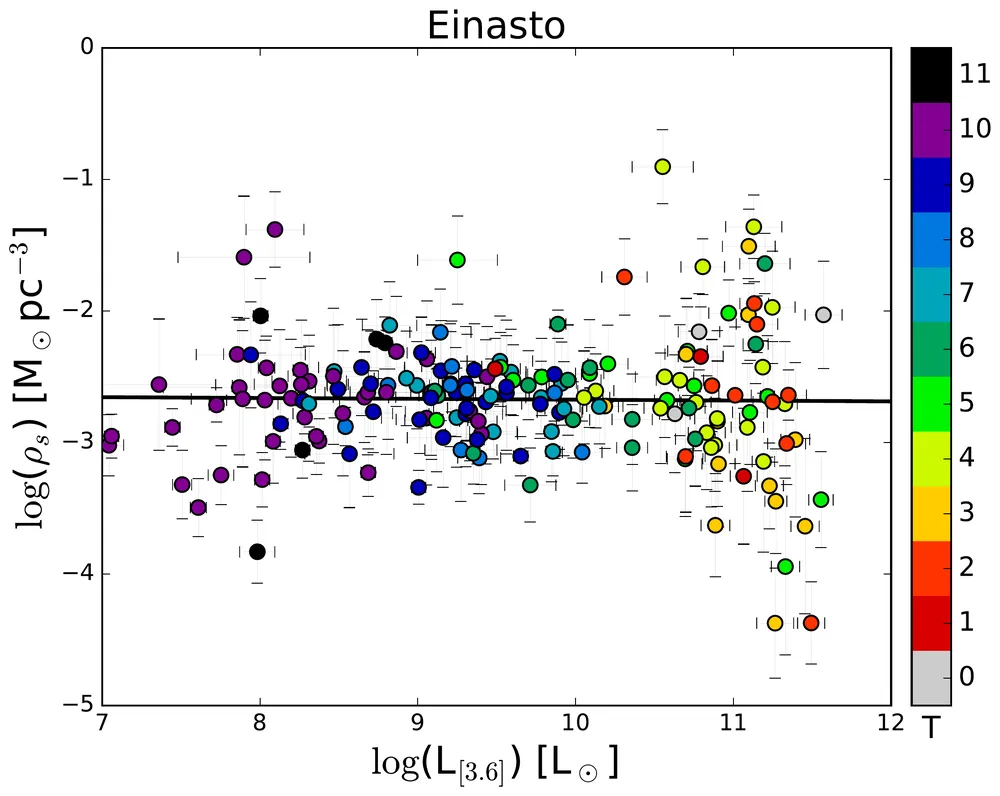
Weighing a galaxy’s dark matter halo is comparatively easy: its rotation curve tells us how much gravitational mass is present. Maximum Discs turned decades of by-eye mass modelling into an algorithm for measuring how much of that gravity can be supplied by stars, while SPARC Halo Density found that haloes have remarkably similar characteristic densities across galaxies spanning five orders of magnitude in brightness. The harder—and more revealing—question is shape. Cold dark matter predicts haloes that are flattened and triaxial; self-interacting dark matter makes them rounder. Stellar streams are ideal probes because their paths trace the gravitational field, preserving a visible record of the halo geometry.

Our work turns that record into a scalable test of dark matter. Potamides showed that projected stream tracks around nearby galaxies can constrain halo shape, using 15 systems; Potamides Software made that inference run in minutes on a laptop. Euclid Extragalactic Streams then took the method beyond the local Universe: it was the first analysis of stellar streams around more distant galaxies, and the first to combine multiple streams in a single joint halo-shape measurement—13 galaxies in Euclid’s first data. The real payoff is statistical: in a round halo, streams cannot curve away from their host galaxy’s centre in projection, while non-spherical haloes can produce such “wrong-way” curves. When Streams Curve Away turns that signature into a population test: across about 10,000 streams, within reach of Euclid, Rubin and Roman, how often those curves appear can distinguish cold dark matter from self-interacting dark matter at up to 5σ.

Potamides: JAX tools for curvature-based inference from stellar streamsPotamides: The SoftwarePotamides Software
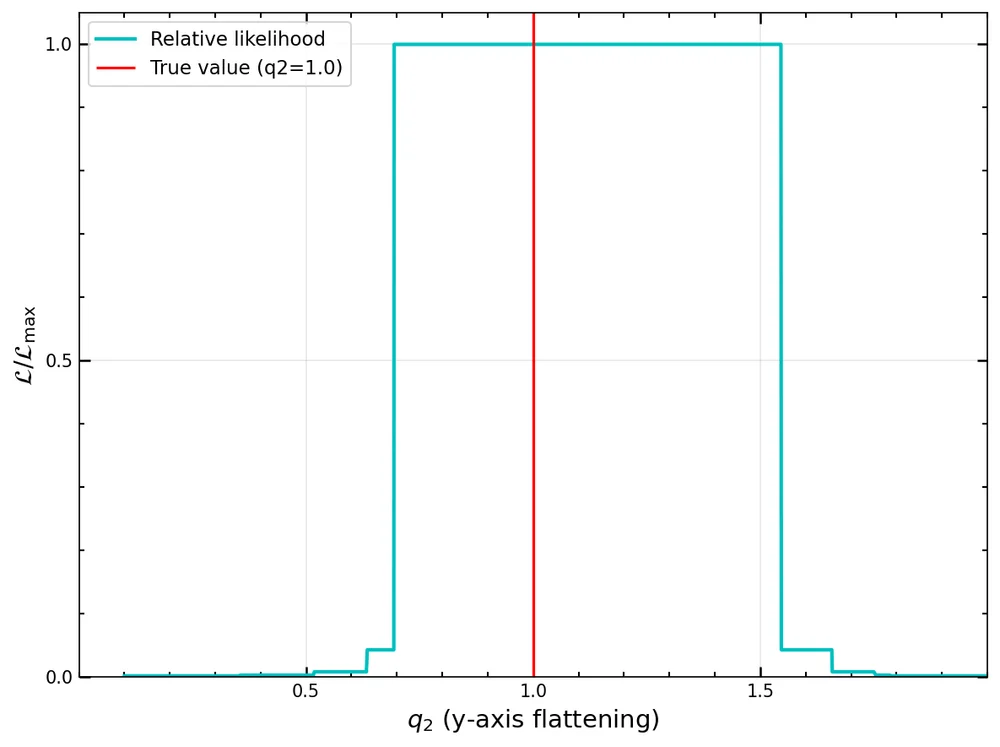
Relative likelihood of a halo’s y-axis flattening, q₂, from a Potamides tutorial: a flat plateau from about 0.7 to 1.55 that contains the true value, q₂ = 1, falling to zero on either side.

Journal of Open Source Software 11, 10712JOSS 11, 10712·2026·S. Wu‡, N. Starkman, et al.S. Wu‡, N. Starkman, J. Nibauer, et al.S. Wu‡, N. Starkman, J. Nibauer, S. Pearson·Journal of Open Source Software 11, 10712JOSS 11, 10712·2026

Journal of Open Source Software 11, 10712JOSS 11, 10712·2026

Potamides is a JAX package that infers a galaxy’s mass distribution from the shapes of its stellar streams.

Potamides is a JAX package that infers a galaxy’s mass distribution from the shapes of its stellar streams. Instead of simulating a stream for every trial potential, it fits the observed track with splines and compares its curvature directly to the potential’s accelerations, covering the pipeline from annotating streams to evaluating likelihoods. Led by Sirui Wu.

2nd | 2026
2026Context ›
When Streams Curve Away: a Test of Dark Matter from Extragalactic Stellar Stream PopulationsWhen Streams Curve Awaysubmitted
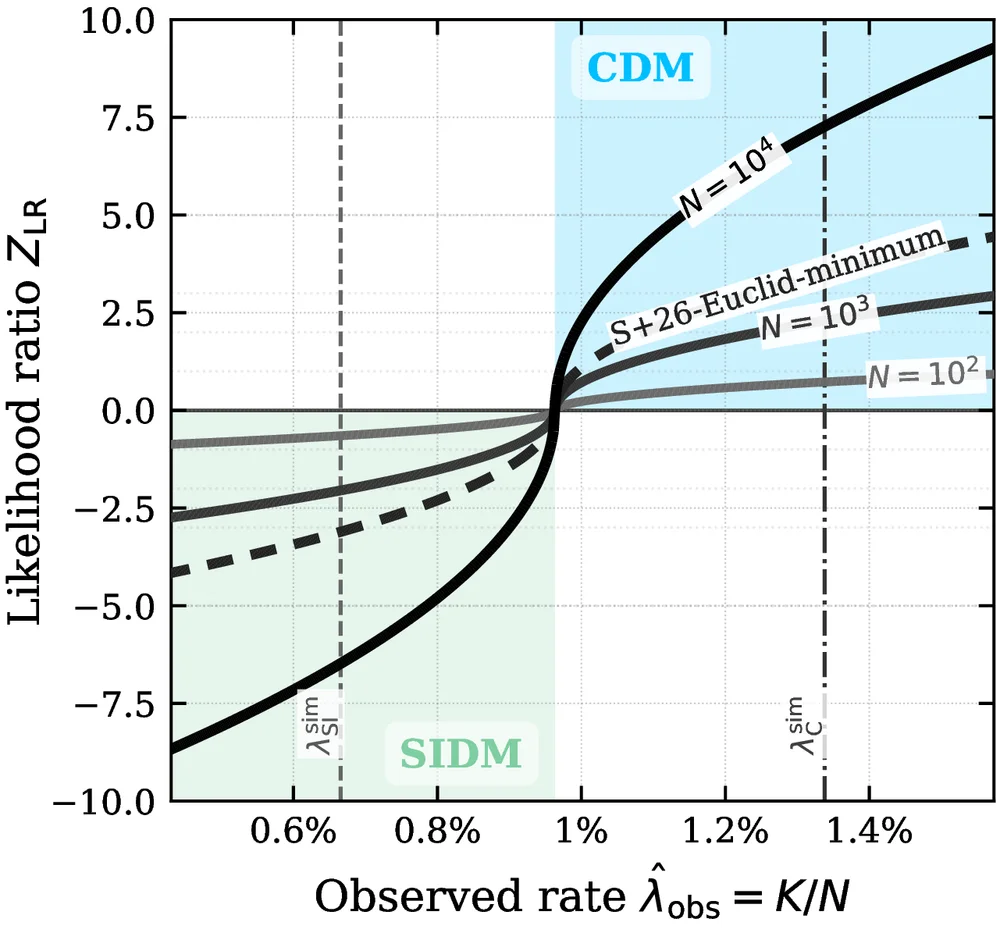
Likelihood ratio between CDM and SIDM plotted against the observed fraction of streams with a convex segment, for catalogs of 100, 1,000 and 10,000 streams. The curves steepen with catalog size; at 10,000 streams, either predicted rate is strongly favored.

arXiv:2609.40057·2026submitted·N. Starkman, J. Nibauer, et al.N. Starkman, J. Nibauer, S. Pearson, et al.N. Starkman, J. Nibauer, S. Pearson, S. Wu‡, L. Necib·arXiv:2609.40057·2026submitted

arXiv:2609.40057·2026submitted

Cold dark matter predicts triaxial halos; self-interacting dark matter rounds them toward spheres.

Cold dark matter predicts triaxial halos; self-interacting dark matter rounds them toward spheres. A stellar stream in a spherical halo can never curve away from its host galaxy’s center in projection, but one in a triaxial halo can. The rate of these convexities tracks halo shape across a population, so catalogs on the scale of Euclid, Rubin and Roman can tell CDM from SIDM at up to 5σ.

1st | 2026
2026Context ›
Euclid Quick Data Release (Q1): The geometry of dark matter halos from extragalactic streamsHalo Geometry from Euclid StreamsEuclid Extragalactic Streamssubmitted
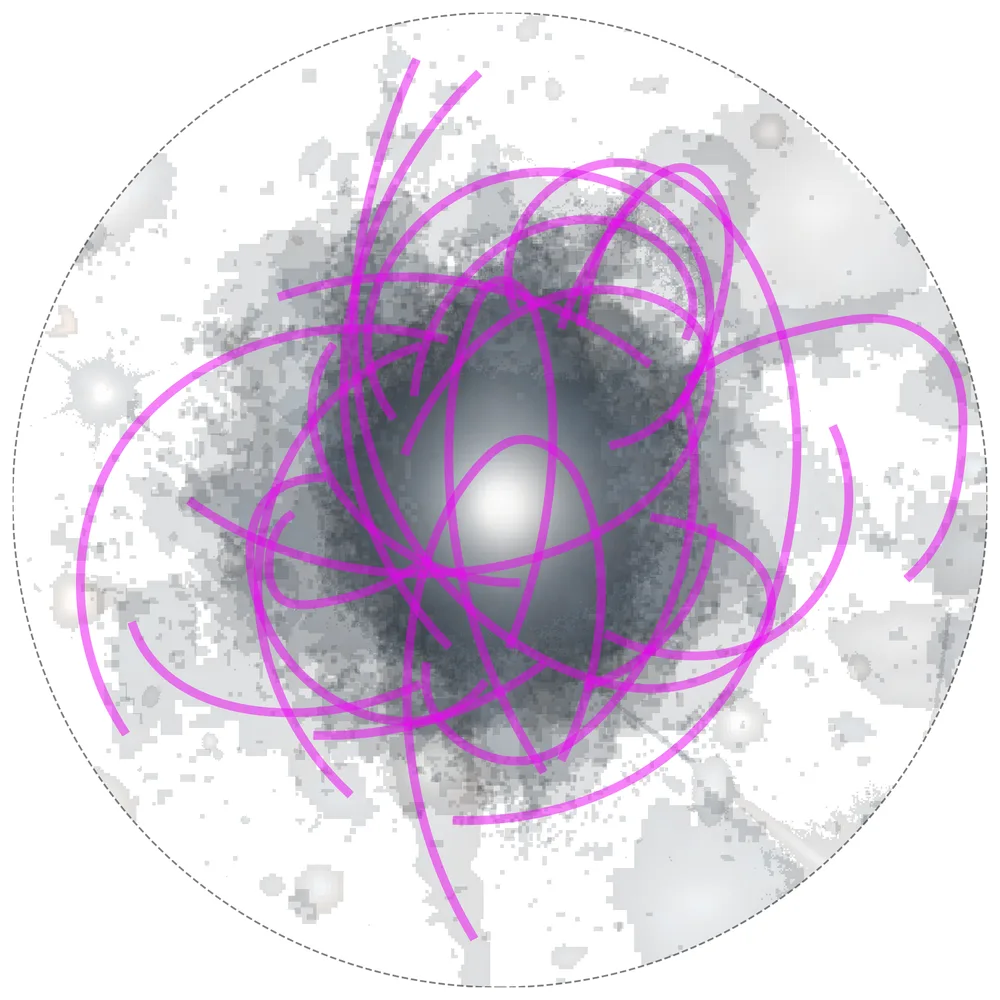
Stellar stream tracks from 13 Euclid galaxies, drawn as magenta curves and stacked over one host galaxy, as if every stream orbits a common center.

Astronomy & AstrophysicsA&A·2026submitted·Euclid Collaboration, N. Starkman, J. Nibauer, et al.Euclid Collaboration, N. Starkman, J. Nibauer, S. Pearson, et al.Euclid Collaboration, N. Starkman, J. Nibauer, S. Pearson, S. Wu‡, M. Walmsley, L. Necib, J. Bovy, F. R. Marleau, et al.·Astronomy & AstrophysicsA&A·2026submitted

Astronomy & AstrophysicsA&A·2026submitted

Euclid is turning up stellar streams around galaxies across a cosmological volume.

Euclid is turning up stellar streams around galaxies across a cosmological volume. A stream’s shape on the sky constrains the shape and center of its host’s dark matter halo, complementing weak lensing. Across 13 galaxies in Euclid’s first quick data release, halos are consistent with spherical, albeit with a mild preference for flattening, q = 0.95 (+0.05, −0.10), in line with ΛCDM. Thousands more streams are expected over the mission.

1st | 2026
2026Context ›
Potamides: Mapping Dark Matter Halo Shapes from Stellar Stream Tracks in the Local UniversePotamides: Halo Shapes from Stream CurvaturePotamidesaccepted
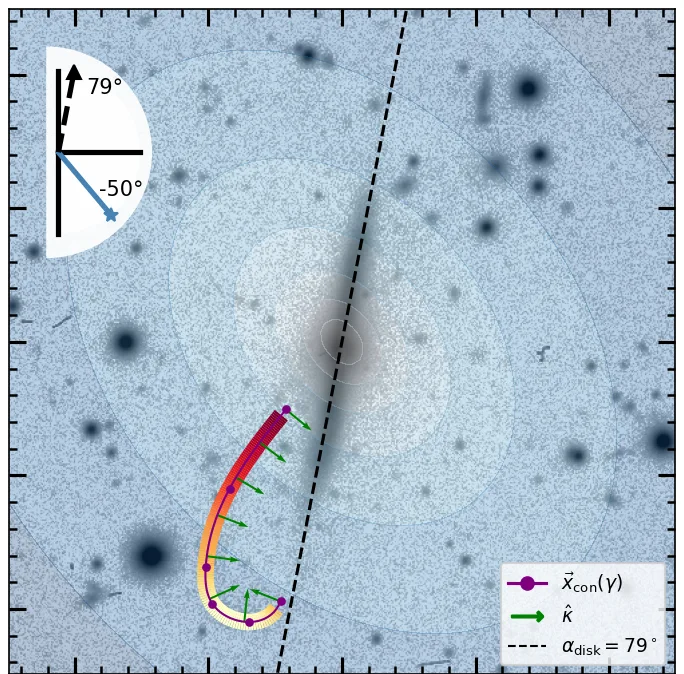
The galaxy ESO 186-063 seen edge-on, with its faint stellar stream fitted as a curved track. Arrows show the stream’s curvature, and the track is shaded by how often each point rejects a trial halo potential, over that potential’s equipotential contours.

The Astrophysical JournalApJ·2026accepted·S. Wu‡, N. Starkman, et al.S. Wu‡, N. Starkman, S. Pearson, et al.S. Wu‡, N. Starkman, S. Pearson, J. Nibauer, J. Miro-Carretero, D. Martinez-Delgado·The Astrophysical JournalApJ·2026accepted

The Astrophysical JournalApJ·2026accepted

A stellar stream’s curvature traces the pull of its host’s dark matter halo.

A stellar stream’s curvature traces the pull of its host’s dark matter halo. Applied to 15 streams from the Stellar Stream Legacy Survey, Potamides constrains each halo’s projected flattening and orientation. Streams with edge-on loops or sharp turns constrain it most, great-circle-like ones barely at all, and three hint that the stellar disk shapes the inner gravitational field. Led by Sirui Wu.

2nd | 2026
2026Context ›
A constant characteristic volume density of dark matter haloes from SPARC rotation curve fitsA Constant Dark-Matter Halo DensitySPARC Halo Density
Characteristic dark-matter density of each SPARC galaxy’s Einasto halo against its 3.6-micron luminosity, coloured by Hubble type from S0 to blue compact dwarf. The points scatter around a flat line across five decades in luminosity.

Monthly Notices of the Royal Astronomical SocietyMNRAS·2018·P. Li, …, N. Starkman, et al.P. Li, …, N. Starkman, et al.P. Li, F. Lelli, S. S. McGaugh, N. Starkman, J. M. Schombert·Monthly Notices of the Royal Astronomical SocietyMNRAS·2018

Monthly Notices of the Royal Astronomical SocietyMNRAS·2018

How dark-matter haloes grow with the galaxies inside them is a direct test of how galaxies form.

How dark-matter haloes grow with the galaxies inside them is a direct test of how galaxies form. Fitting the rotation curves of 175 SPARC galaxies shows that bigger galaxies have bigger haloes, but the haloes’ typical density stays about the same — across galaxies that differ a hundred-thousand-fold in brightness.

nth | 2018
2018Context ›
A new algorithm to quantify maximum discs in galaxiesQuantifying Maximum DiscsMaximum Discs
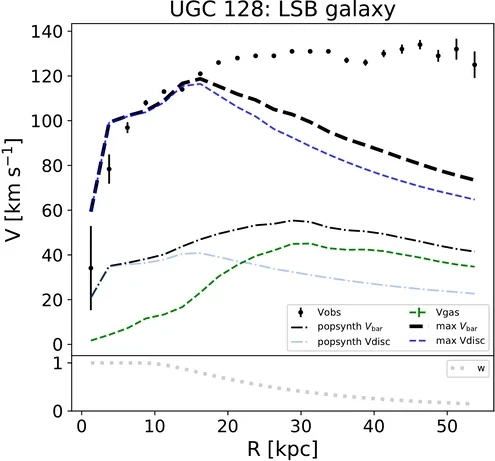
Rotation curve of the low-surface-brightness galaxy UGC 128: the observed speeds as points with error bars, the gas contribution, and the stellar disc and total baryonic contributions at both the stellar-population mass-to-light ratio and the maximum-disc value. Making its disc maximal needs a far heavier disc than its stars imply.

Monthly Notices of the Royal Astronomical Society 480, 2292MNRAS 480, 2292·2018·N. Starkman, F. Lelli, et al.N. Starkman, F. Lelli, S. S. McGaugh, et al.N. Starkman, F. Lelli, S. S. McGaugh, J. Schombert·Monthly Notices of the Royal Astronomical Society 480, 2292MNRAS 480, 2292·2018

Monthly Notices of the Royal Astronomical Society 480, 2292MNRAS 480, 2292·2018

A galaxy’s rotation comes from both its stars and its dark matter.

A galaxy’s rotation comes from both its stars and its dark matter. A “maximum disc” gives the stars as much of that rotation as possible, but the term was never precisely defined. A new algorithm measures it across 153 SPARC galaxies: bright galaxies come close to a maximum disc, while faint ones cannot — their stars would have to be unrealistically heavy for their light.

1st | 2018
2018Context ›

Galactic

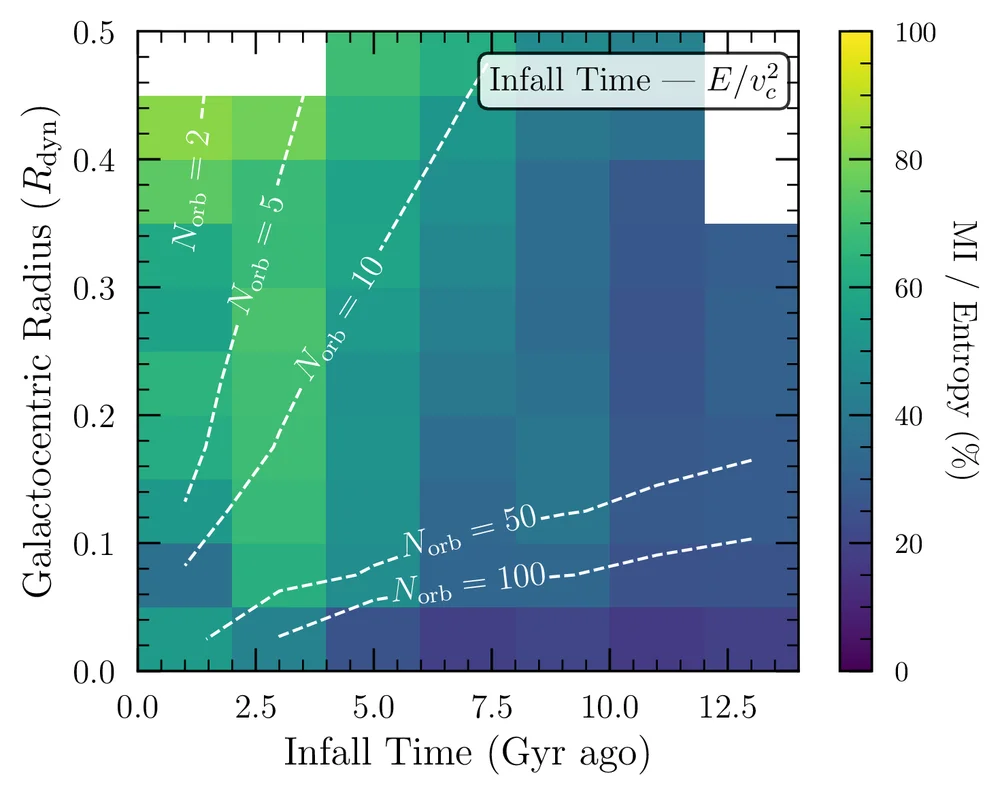
Galaxies forget. Stars that arrived in the same merger are gradually stirred into the Milky Way’s background, erasing the record of how it was assembled. Galactic Amnesia measures this loss of memory: radial velocities forget a merger’s mass and timing within about 5 billion years, but orbital energies retain the signal for more than 10—provided we know the Galaxy’s gravitational potential. Stellar streams are the exception. They are stars stripped from one cluster and stretched along nearly a single orbit, so one snapshot reveals a path that would take a single star hundreds of millions of years to trace. Extended Pal 5 nearly doubled the known length of Palomar 5’s leading tail; Stream Members Only identifies a stream’s members star by star; and On the Fast Track maps a stream’s path in about a second, without assuming a model for the Milky Way.

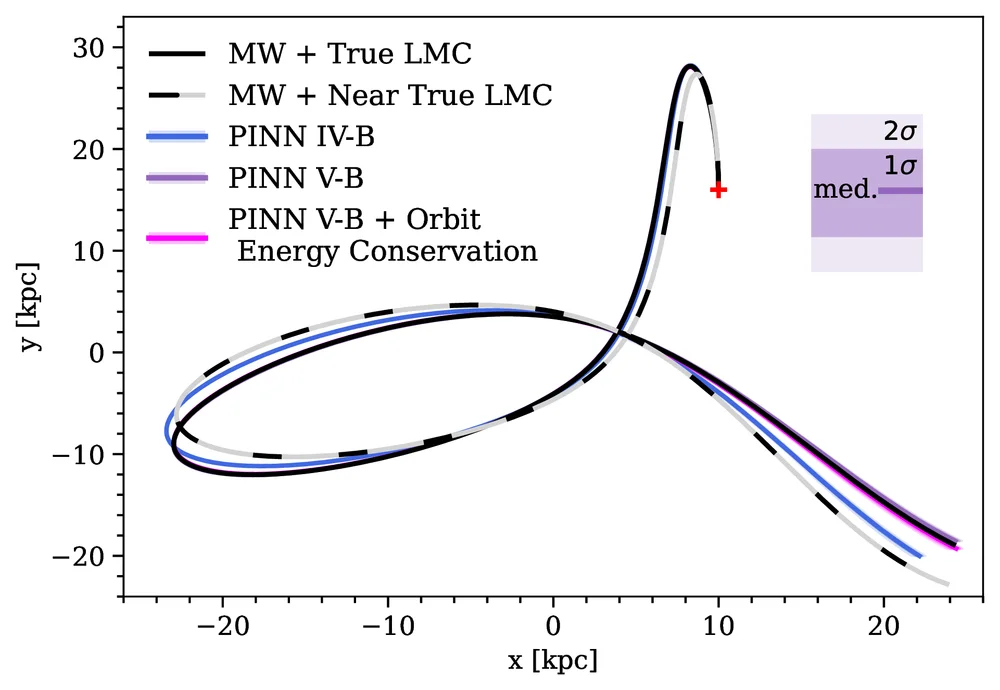
Streams probe dark matter on both large and small scales: the Galaxy-wide gravitational potential that guides their orbits, and the compact dark-matter clumps that perturb them. StreamSculptor finds that GD-1 may have been struck by up to a hundred subhaloes too small to form stars, leaving its stars moving about three times more randomly than an undisturbed stream would—just what cold dark matter predicts. Galactic PINNs learns the potential itself from measured accelerations: tested on simulated Milky Ways, it recovers the influence of both the Galactic bar and the Large Magellanic Cloud even when neither is included in the starting model.

Reconstructing Galactic Gravitational Potentials from Stellar Kinematics with Physics-Informed Neural NetworksPINNs for Galactic PotentialsGalactic PINNssubmitted
Orbits of a test particle in a Milky Way–LMC system, integrated in the true potential, a near-true analytic model, and three neural-network models. The most complete neural-network models track the true orbit almost exactly, while the near-true analytic model drifts away from it.

Monthly Notices of the Royal Astronomical SocietyMNRAS·2026submitted·C. Myers†, N. Starkman, et al.C. Myers†, N. Starkman, L. NecibC. Myers†, N. Starkman, L. Necib·Monthly Notices of the Royal Astronomical SocietyMNRAS·2026submitted

Monthly Notices of the Royal Astronomical SocietyMNRAS·2026submitted

A physics-informed neural network learns only the corrections to an analytic galactic potential, so it stays interpretable while reaching sub-percent acceleration errors and more faithful orbits than analytic models alone.

A physics-informed neural network learns only the corrections to an analytic galactic potential, so it stays interpretable while reaching sub-percent acceleration errors and more faithful orbits than analytic models alone. Bayesian and time-dependent extensions add uncertainties and follow the potential as it evolves. Led by undergraduate Charlotte Myers; code in galactoPINNs, first shown at NeurIPS 2025.

2nd | 2026
2026Context ›
Galactic Amnesia: The Information Washout of the Milky Way Merger HistoryGalactic Amnesiasubmitted
Heat map of how much a merger’s present-day orbital energy reveals about its infall time, by infall time and galactocentric radius. Memory is highest for recent mergers in the outer galaxy and fades for older mergers and toward the center, following dashed lines of constant orbit count.

arXiv:2605.04138·2026submitted·L. Necib, …, N. Starkman, et al.L. Necib, …, N. Starkman, et al.L. Necib, D. Folsom, E. Y. Davies, N. Starkman, A. Thoyas·arXiv:2605.04138·2026submitted

arXiv:2605.04138·2026submitted

Mergers leave fingerprints on a galaxy’s stars, but orbits mix and the record fades.

Mergers leave fingerprints on a galaxy’s stars, but orbits mix and the record fades. In 98 simulated Milky Ways, a merger’s imprint on stellar energy outlasts 10 Gyr, while radial velocity forgets within about 5 Gyr. To read the Milky Way’s past, we first need its potential.

nth | 2026
2026Context ›
StreamSculptor: Hamiltonian Perturbation Theory for Stellar Streams in Flexible Potentials with Differentiable SimulationsStreamSculptor
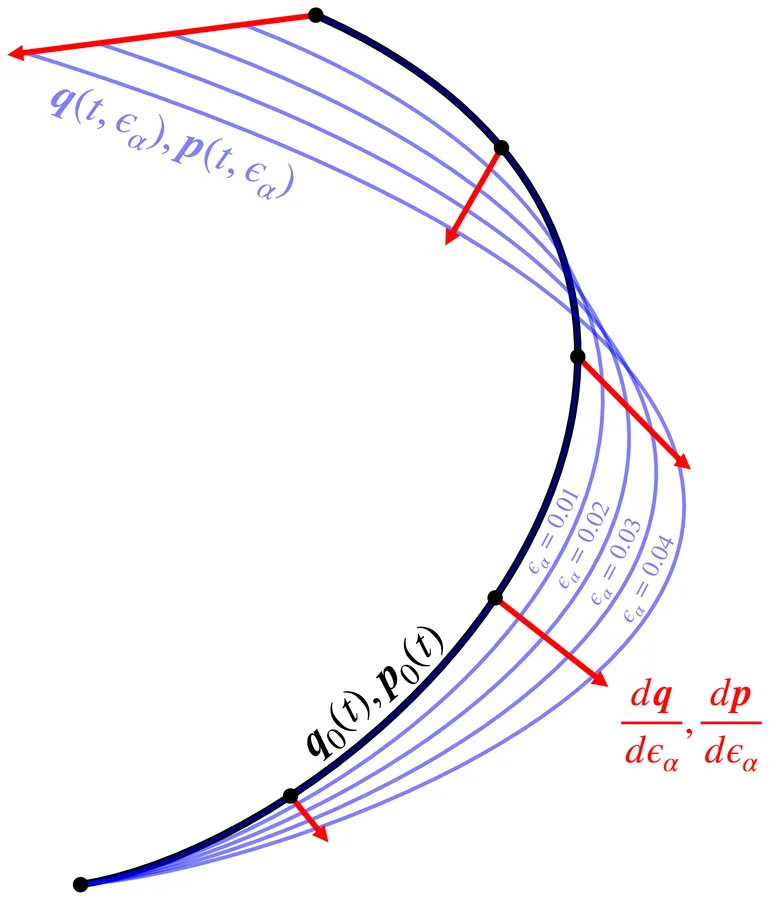
Sketch of the method: a black base orbit with a fan of blue orbits beside it, each bent a little further as the perturbation strength grows from 0.01 to 0.04. Red arrows along the base orbit show the derivatives that predict that bending.

The Astrophysical Journal 983, 68ApJ 983, 68·2025·J. Nibauer, …, N. Starkman, et al.J. Nibauer, …, N. Starkman, et al.J. Nibauer, A. Bonaca, D. N. Spergel, A. M. Price-Whelan, J. E. Greene, N. Starkman, K. V. Johnston·The Astrophysical Journal 983, 68ApJ 983, 68·2025

The Astrophysical Journal 983, 68ApJ 983, 68·2025

Stellar streams are sensitive to the smallest dark matter subhalos.

Stellar streams are sensitive to the smallest dark matter subhalos. StreamSculptor uses Hamiltonian perturbation theory to model streams in time-dependent potentials, capturing the LMC and the Galactic bar alongside the dozens of subhalo impacts expected for streams like GD-1 and Pal 5. A stream’s velocity dispersion then ties directly to dark matter physics, giving a fast way to model whole stream populations from dark matter properties. Led by Jacob Nibauer.

nth | 2025
2025Context ›
Stream Members Only: Data-Driven Characterization of Stellar Streams with Mixture Density NetworksStream Members Only
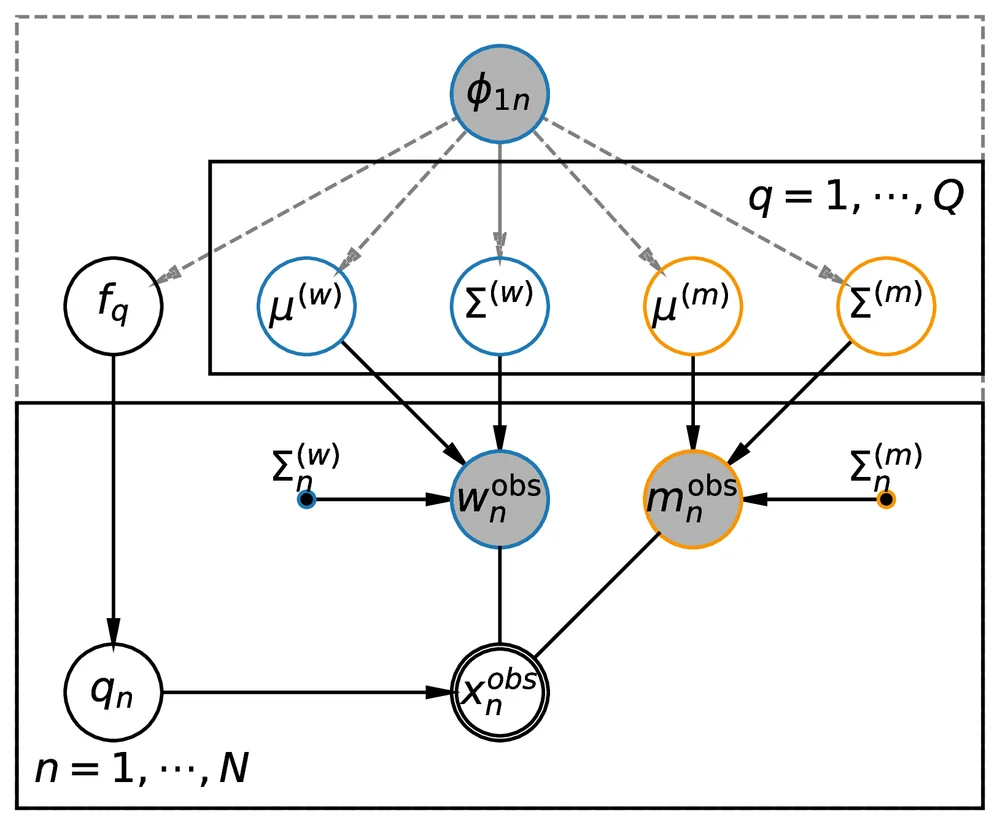
Probabilistic graphical model of the stream: each star’s observed astrometry and photometry come from a mixture of Gaussians whose weights, means and covariances are set by neural networks of its position along the stream, with each star’s measurement errors feeding in.

The Astrophysical Journal 980, 253ApJ 980, 253·2025·N. Starkman, J. Nibauer, et al.N. Starkman, J. Nibauer, J. Bovy, et al.N. Starkman, J. Nibauer, J. Bovy, J. Webb, K. Tavangar, A. Price-Whelan, A. Bonaca·The Astrophysical Journal 980, 253ApJ 980, 253·2025

The Astrophysical Journal 980, 253ApJ 980, 253·2025

Using a stellar stream to weigh the Milky Way’s dark matter starts with knowing which stars belong to it.

Using a stellar stream to weigh the Milky Way’s dark matter starts with knowing which stars belong to it. Mixture density networks model a stream’s track, width, density and kinematics from all the available astrometry and photometry, with normalizing flows for the background, even where phase-space data are incomplete. Applied to GD-1 and Palomar 5, the result is public catalogs of stellar membership probabilities.

1st | 2025
2025Context ›
On the fast track: Rapid construction of stellar stream pathsOn the Fast Track
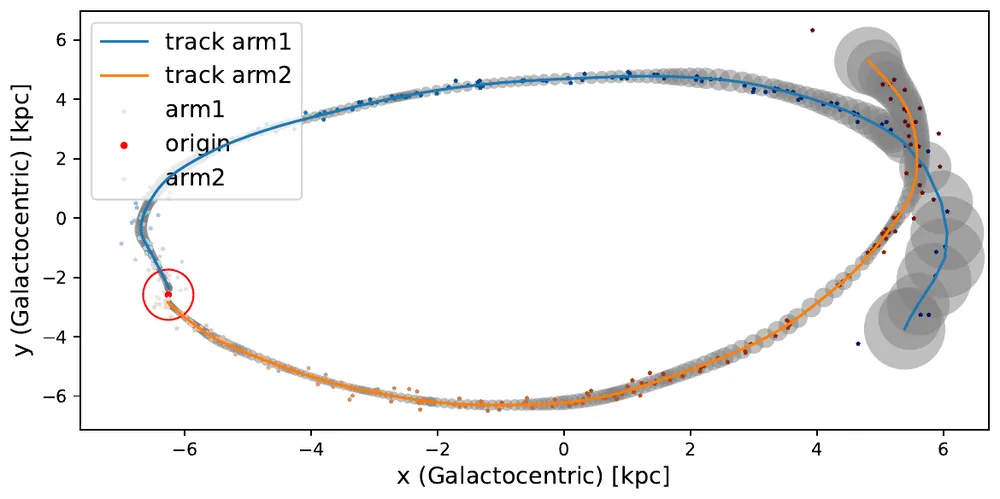
A simulated stellar stream from a 47 Tucanae-like progenitor, looping around the Galactic centre in Galactocentric x–y coordinates. Blue and orange lines trace the fitted path of each tidal arm, wrapped in grey uncertainty ellipses that grow largest at the arms’ sparse far ends.

Monthly Notices of the Royal Astronomical Society 522, 5022MNRAS 522, 5022·2023·N. Starkman, J. Bovy, et al.N. Starkman, J. Bovy, J. Webb, et al.N. Starkman, J. Bovy, J. Webb, D. Calvetti, E. Somersalo·Monthly Notices of the Royal Astronomical Society 522, 5022MNRAS 522, 5022·2023

Monthly Notices of the Royal Astronomical Society 522, 5022MNRAS 522, 5022·2023

Comparing a stellar stream to simulations first needs a clear map of the stream’s path.

Comparing a stellar stream to simulations first needs a clear map of the stream’s path. This method puts the stars in order along the stream, then traces the path and its uncertainty — without assuming any model of the Galaxy. It works on simulated streams and on real ones like Palomar 5 and GD-1, and is available as the Python package TrackStream.

1st | 2023
2023Context ›
An extended Pal 5 stream in Gaia DR2An Extended Pal 5 Stream in Gaia DR2Extended Pal 5
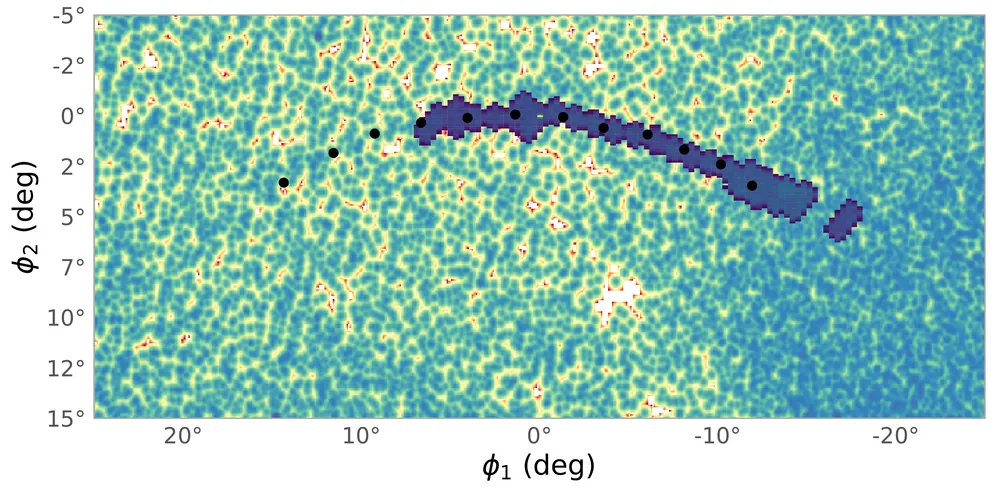
Smoothed density map of Gaia DR2 stars around the Palomar 5 globular cluster, in coordinates aligned with its tidal tails. A dark band marks the stream detected in earlier CFHT data, mostly the trailing arm; black dots trace the tails found here, matching that band and continuing about 7 degrees further along the leading arm.

Monthly Notices of the Royal Astronomical SocietyMNRAS·2020·N. Starkman, J. Bovy, et al.N. Starkman, J. Bovy, J. WebbN. Starkman, J. Bovy, J. Webb·Monthly Notices of the Royal Astronomical SocietyMNRAS·2020

Monthly Notices of the Royal Astronomical SocietyMNRAS·2020

Palomar 5 is a star cluster being pulled apart by the Milky Way, leaving two tails of stars that trace the Galaxy’s gravity.

Palomar 5 is a star cluster being pulled apart by the Milky Way, leaving two tails of stars that trace the Galaxy’s gravity. Gaia data show its leading tail runs about 7° further than was known, making the stream about 30° long. The two tails come out roughly equal, which limits how much the Galactic bar can have cut one short.

1st | 2020
2020Context ›

Cosmic Microwave Background

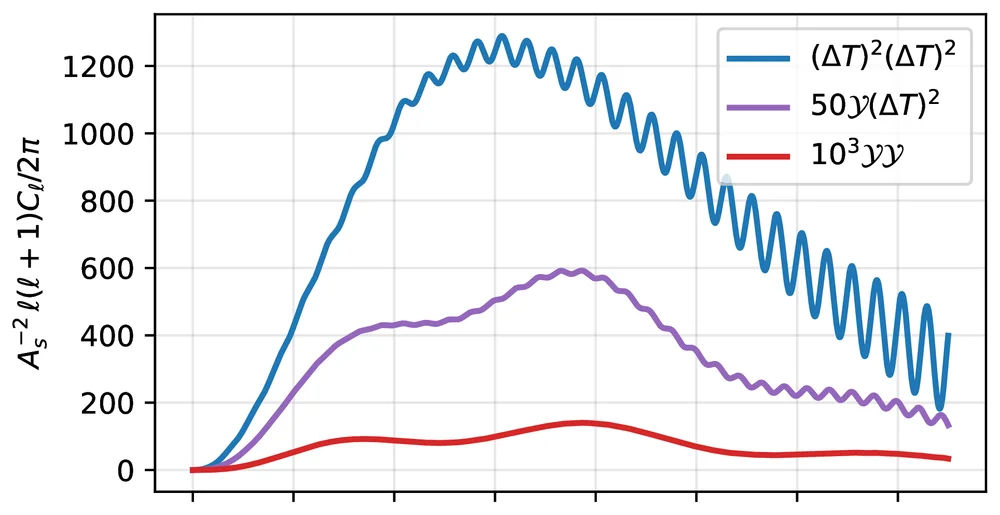
The cosmic microwave background is almost a perfect blackbody, but its tiny spectral distortions contain information that its temperature map cannot provide. In CMB Spectrum Distortions, we calculate a signal that standard cosmology must produce. As the Universe became transparent, photons diffused out of hotter and colder regions, mixing blackbodies with slightly different temperatures. That mixing created a faint Compton y-distortion that is largest where the temperatures being mixed differ most, so it correlates with the squared temperature map. That correlation should already be detectable with ACT and SPT, at a signal-to-noise of about 12, opening a new observational test of early-Universe physics.

Angular Correlations of Cosmic Microwave Background Spectrum Distortions from Photon DiffusionCMB Spectrum Distortions from Photon DiffusionCMB Spectrum Distortions
Angular power spectra of the squared temperature fluctuations (blue), their cross-correlation with the diffusion y-distortion (purple, scaled by 50), and the y-distortion’s own autocorrelation (red, scaled by 1000). The blue and purple curves carry acoustic oscillations.

Monthly Notices of the Royal Astronomical Society 529, 2274MNRAS 529, 2274·2024·N. Starkman, G. Starkman, et al.N. Starkman, G. Starkman, A. KosowskyN. Starkman, G. Starkman, A. Kosowsky·Monthly Notices of the Royal Astronomical Society 529, 2274MNRAS 529, 2274·2024

Monthly Notices of the Royal Astronomical Society 529, 2274MNRAS 529, 2274·2024

As the universe became transparent, the photons reaching us from any one direction last scattered off regions at slightly different temperatures.

As the universe became transparent, the photons reaching us from any one direction last scattered off regions at slightly different temperatures. Blending those blackbodies leaves a small Compton y-distortion in the CMB spectrum. Its cross-correlation with the squared temperature fluctuations should already be detectable by ACT and SPT, at a forecast signal-to-noise of about 12, and CMB-S4 could turn it into a new cosmological probe.

1st | 2024
2024Context ›

Dark Matter Direct Detection

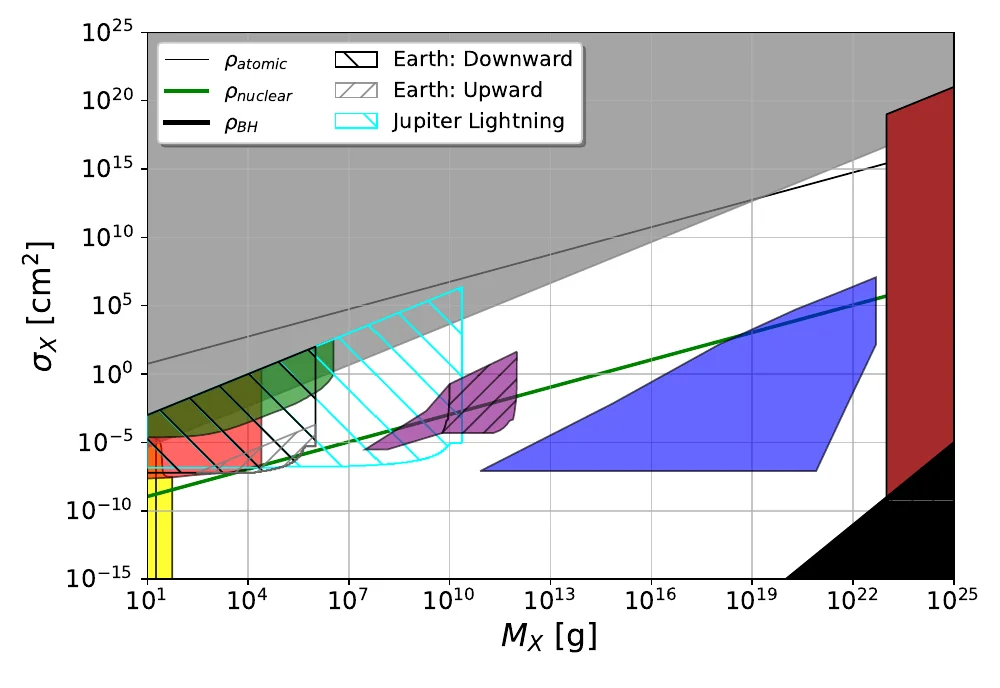
Direct detection usually means placing a shielded detector underground and waiting for a dark-matter particle to scatter. But if dark matter comes in macroscopic objects—far heavier, and therefore far rarer, than ordinary particle candidates—no laboratory detector is large enough to expect an encounter. In Macro Lightning, we turn the atmosphere into the detector instead. A macro passing through a thunderstorm would leave a long, straight channel of ionized air that could seed a lightning bolt straight as a ruler, unlike the jagged bolts produced by ordinary storms; the odds of ordinary lightning running even ten steps that straight are about 3 in 10 trillion. Searching for straight lightning on Earth, or even on Jupiter, turns thunderstorms into planet-sized dark-matter experiments.

Straight Lightning as a Signature of Macroscopic Dark MatterStraight Lightning from Macroscopic Dark MatterMacro Lightning
Macro dark matter parameter space, cross-section against mass, both on log axes. Colored regions are existing constraints; black and grey hatching marks what a search for straight lightning on Earth could probe, and cyan hatching what Jupiter could, reaching to heavier macros than the Earth search.

Physical Review D 103, 063024PRD 103, 063024·2020·N. Starkman, J. S. Sidhu, et al.N. Starkman, J. S. Sidhu, H. Winch, et al.N. Starkman, J. S. Sidhu, H. Winch, G. Starkman·Physical Review D 103, 063024PRD 103, 063024·2020

Physical Review D 103, 063024PRD 103, 063024·2020

Dark matter might be large objects — macros — rather than tiny particles.

Dark matter might be large objects — macros — rather than tiny particles. A macro passing through a thunderstorm would trigger a perfectly straight lightning bolt, unlike the jagged bolts we normally see. Looking for straight lightning on Earth, or on Jupiter, could test this idea.

1st | 2020
2020Context ›

Conferences

Every talk, poster and workshop, and where it happened:

one talkfour — a pin's area is its countEqual Earth projection
Online — 11 talksCleveland, OH, USA — 9 talksToronto, ON, Canada — 9 talksCambridge, MA, USA — 4 talksCopenhagen, Denmark — 3 talksAtlanta, GA, USA — 2 talksJesi, Italy — 2 talksLausanne, Switzerland — 2 talksNew York, NY, USA — 2 talksParis, France — 2 talksSanta Cruz, CA, USA — 2 talksValencia, Spain — 2 talksA Coruña, Spain — 1 talkBoston, MA, USA — 1 talkCollege Station, TX, USA — 1 talkCórdoba, Spain — 1 talkDurham, UK — 1 talkHamilton, ON, Canada — 1 talkIthaca, NY, USA — 1 talkPasadena, CA, USA — 1 talkPittsburgh, PA, USA — 1 talkPortoferraio, Italy — 1 talkPortsmouth, UK — 1 talkPotsdam, Germany — 1 talkPrinceton, NJ, USA — 1 talkRochester, NY, USA — 1 talkSeattle, WA, USA — 1 talk
1 talk not on the map
  1. A Coruña, Spain 1 talk

  2. Atlanta, GA, USA 2 talks

  3. Boston, MA, USA 1 talk

  4. Cambridge, MA, USA 4 talks

  5. Cleveland, OH, USA 9 talks

  6. College Station, TX, USA 1 talk

  7. Copenhagen, Denmark 3 talks

  8. Córdoba, Spain 1 talk

  9. Durham, UK 1 talk

  10. Hamilton, ON, Canada 1 talk

  11. Ithaca, NY, USA 1 talk

  12. Jesi, Italy 2 talks

  13. Lausanne, Switzerland 2 talks

  14. New York, NY, USA 2 talks

  15. Online 11 talks

  16. Paris, France 2 talks

  17. Pasadena, CA, USA 1 talk

  18. Pittsburgh, PA, USA 1 talk

  19. Portoferraio, Italy 1 talk

  20. Portsmouth, UK 1 talk

  21. Potsdam, Germany 1 talk

  22. Princeton, NJ, USA 1 talk

  23. Rochester, NY, USA 1 talk

  24. Santa Cruz, CA, USA 2 talks

  25. Seattle, WA, USA 1 talk

  26. Toronto, ON, Canada 9 talks

  27. Valencia, Spain 2 talks

1 talk not placed yet

Where these happened is recorded in #22 and not yet settled.

  1. Aug 2017Origins Cruise to the British Isles, Iceland and Norway (Talk)invited talk